Loading page…
Loading answer…
Open full answer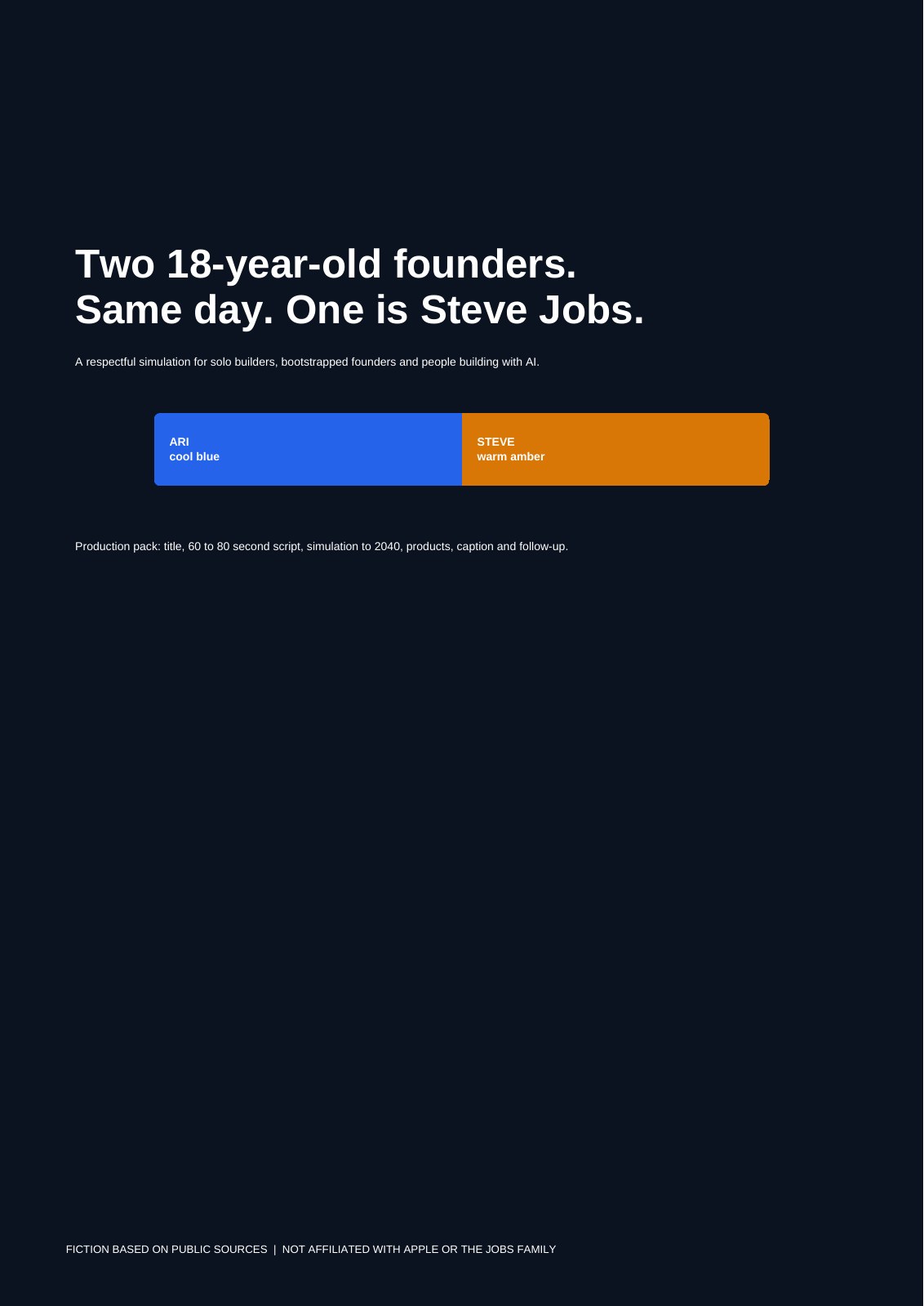
Loading…
Agent startup vs Steve Jobs: company value after five years?
"Agent startup" stays cool blue. "Steve Jobs" stays warm amber. The line stays pinned for all 78 seconds.
Alternatives: "Default founder vs Steve Jobs: who is ahead in five years?" and "The agent founder vs Steve Jobs: what does five years actually measure?"
78 seconds. Blue left: Maya Chen, 18, Somerville. Amber right: Steve Jobs, same mind and taste, 18, no old life replayed. Faceless figures. Cambridge, November 12, 2026.
| Time | What we see | Narration |
|---|---|---|
| 0:00-0:03 | Split screen, same street, day one. Title pinned in both colors. | Two eighteen-year-olds start in Cambridge on November 12, 2026. One is Steve Jobs. |
| 0:03-0:11 | Left: Relay, a prior-auth agent. Right: Kendall Square bench, research cartridge, blank card. Label: Start with the feeling. | Maya Chen builds the agent hospitals will buy. Steve starts with the feeling, a card a father can hold. |
| 0:11-0:19 | Left: $14 million seed, blue board seat. Right: $2.2 million, 8 percent sold, training clause crossed out. Label: Own the whole thing, including the no. | Maya raises fourteen million and gives the board a vote. Steve takes less, so the product can stay whole. |
| 0:19-0:27 | Left: three open doors. Right: two-by-two, one box filled. Lab, robot, and patch shut. Exact: "Focusing is about saying 'no.'" | Maya says yes to the work the round rewards. Steve says no to a lab, a robot, and a patch. |
| 0:27-0:32 | 2027: Hampshire Street, 400 units, "Real artists ship." 2028: export blocked, a patient waited nine days. 2029: the plain file ships. | Five years later. Intelligence got cheaper, and the scoreboard did not. |
| 0:32-0:40 | Company value. Relay $4.0 billion, tall blue bar. Sunday $620 million, short amber bar. Check on Maya, then a crack. | Company value says Maya won. Company value is the wrong ruler. |
| 0:40-0:48 | Inside customers, each color glowing. Left: departments, contracts graying. Right: kitchens, fridge card, 71 percent back weekly. Label: A feature gets cheaper. A ritual does not. | Maya's departments leave when a frontier model gets cheap. A person comes back to Steve every week. |
| 0:48-0:56 | Inside cap table and team. Maya owns 11 percent. Payer option on the blue seats. Steve owns 54 percent. Writer, physician, designer remain. Exact: "I'm actually as proud of many of the things we haven't done as the things we have done." | Maya owns eleven percent, so the board can sell the roadmap. Steve kept the no, and the team stayed. |
| 0:56-1:04 | Inside the product. Left: forty workflows. Right: one card. The 48-marker cartridge, 60 percent of cartridge revenue, goes dark. Label: Say no, then finish. Then kill the hit. | Maya's agent does forty jobs. Steve killed the bestselling cartridge. |
| 1:04-1:12 | Left: billing office empties at 5, not 9. Right: Miguel Ruiz, 63, Worcester, clicks a cartridge in. A nurse calls. Miguel walks Elena, 7, to school. | Miguel Ruiz, sixty-three, Worcester, gets one sentence and a nurse. Miguel walks Elena to school on an ordinary Tuesday. |
| 1:12-1:18 | Both figures standing. Title still pinned. | Tomorrow, cut one yes and finish the feeling. Who should we do next? |
Later figures are fiction.
| Year | World | Maya Chen, Relay (blue) | Steve Jobs, Sunday (amber) |
|---|---|---|---|
| 2026 | Anthropic IPO target up to about $1.4 trillion. 29 neolabs, about $23 billion, little to sell. Mercor run rate $3 billion. OpenAI quarter about $10 billion, IPO framed for 2027. One town voted yes on data centers. Ternus is CEO. Folding iPhone about $2,000. Entry software jobs near 20 percent down. | Builds a prior-auth agent. Pays nurses for traces. Raises $0. Learns money funds portals. | Licenses a lab microsampler. A frontier lab refuses a training ban. Raises $0. Learns the cartridge sat unused. |
| 2027 | Price war. 1X ships the $20,000 NEO, still teleoperated. | Raises $14 million and a board seat. Learns speed sells. | Ships 400 units, $1,290 and $39 a month. Raises $2.2 million for 8 percent. Learns the sentence wins. |
| 2028 | Cheap models enter hospital software. | Raises $40 million. Revenue about $9 million. Sells traces. Adds a coding agent. | Opens Oakland and Austin. Blocks a plain export. A patient waits nine days. Learns taste became a wall. |
| 2029 | No consensus AGI. Karpathy's 2025 decade mark is still ahead. | Revenue about $48 million. Three products. | Ships the plain file. Kills the 48-marker hit. 8,000 homes. Revenue dips. |
| 2030 | Goldman still points at plants first. | Valued at $1.1 billion. Adds a neolab slide. Owns about 18 percent. | Opens the Room at $129. No robot. 40,000 homes. Owns 61 percent. |
| 2031 | Intelligence is cheaper than in 2026. | Worth $4.0 billion. Owns 11 percent. Auth nearer 9 hours than 12 days. | Worth $620 million. 180,000 homes. 71 percent weekly return. Owns 54 percent. |
| 2032 | Automated-coder medians about 2028 to the early 2030s. | Coding agent churns. Stake to 9 percent. | 420,000 homes. Hires dropped software writers. A person finishes every red card. |
| 2033 | General models bundle prior auth. | Sells the data line for $1.6 billion. Back to one workflow. | Ships Line. Miguel's card gains the call. |
| 2034 | Apple health is still a phone summary. | Payer contract. Denials speed up. Scholarship starts. | Price cut to $790 and $29. No teen app. |
| 2035 | Goldman: about 6.5 million humanoids, mostly plants. | Profitable line item. Patients never meet Relay. | 2.4 million homes. Still no robot. |
| 2036 | Ten years after Karpathy's decade remark. No agreed AGI here. | Payer freezes the roadmap. Wealth is real. Control is not. | Retires insight-as-hero. The handled week is the product. |
| 2037 | Displacement stays uneven. | Moves toward chair. Scholarship at 200. | Worcester contract, $9 a month. Same card for a family that cannot pay $1,290. |
| 2038 | Recession only in this story. Goldman had said layoffs may wait on a downturn. | Features pause. Saved clerk hours remain. | Hires 800 guides. Caps hours, remembering 2028. |
| 2039 | Models are infrastructure. | Auth layer remains. Clerks still leave earlier. No new round. | About 9 million homes. No new round. A writer still owns the red-card voice. |
| 2040 | Both are 32. No anti-aging claim. | Larger net worth. The board seat was the expensive yes. | Miguel, 72, still walks a child to school. The win is finished weeks, not a new mind. |
Sunday box, 2027. A book-sized counter instrument, not a mirror, patch, wearable, or agent dial. Once a week you click in a finger-stick cartridge, talk for ninety seconds, and a card prints three numbers and one sentence. Labs already sell that microsampler. A model may draft. A person finishes every red card. A nurse calls the same day. Price: $1,290 and $39 a month, later $790 and $29, then $9 on a city contract. Replaces the portal, the lab chat, and the wearable graph. So Steve because the feeling came first, an unused lab object became the whole thing, and the launch was a card read aloud.
The Room, 2030. Forty minutes with a guide and a physician, history on the table. You book and sit. $129, or included twice a year. Replaces the annual visit you skip. So Steve because the store is part of the product, and a person beats a $20,000 robot that still needs an operator.
Line, 2033. The handled week: card, call, walk, meal list, and a doctor who decides the refill or the stop. Included in the month. Replaces spam telehealth. So Steve because the praised cartridge died, then the insight-card died, before a phone dashboard could copy either.
Two 18-year-olds start in Cambridge on the same day, with the same tools. Five years later, the agent company is worth far more. The week that changed belongs to the cheaper company.
✔ Start with the object in a person's hand, then force the technology to serve that feeling. ✔ Say no to the round, the robot, and the extra marker. Whose money you take is who you can refuse. ✔ Kill the hit when it stops being true. Ship the smaller thing, and make the launch part of it.
What would you cut this week if only the part a tired person would miss could stay?
Sources
"Focusing is about saying 'no.'" Steve Jobs, Apple Worldwide Developers Conference, 1997.
"I'm actually as proud of many of the things we haven't done as the things we have done." Steve Jobs, Fortune interview, 2008.
"Real artists ship." Attributed to Steve Jobs by the original Macintosh team, 1983.
Two-by-two, four products, one per quadrant: Walter Isaacson, Steve Jobs, 2011. Method only. Not the old grid.
Anthropic IPO target up to about $1.4 trillion: The New York Times, November 10, 2026.
29 neolabs, about $23 billion, most with nothing to sell: Dealroom, October 19, 2026.
Mercor, $3 billion revenue run rate: Dealroom, 2026.
OpenAI quarter about $10 billion: Reuters, November 10, 2026. IPO framed for 2027: Reuters, November 5, 2026.
One U.S. town voted yes on data centers: The Washington Post, November 8, 2026.
John Ternus, Apple CEO from September 1, 2026: Fortune, September 1, 2026. Foldable iPhone about $2,000: Reuters, October 23, 2026.
Entry-level software jobs down nearly 20 percent: The College Investor, June 9, 2026, on Stanford Digital Economy Lab, "Canaries in the Coal Mine?", 2025 to 2026.
1X NEO, $20,000, teleoperation: Engadget, October 29, 2025. Deliveries with a teleoperator: Startup Fortune, October 21, 2026.
AI price war: Fortune, September 22, 2026.
Andrej Karpathy, AGI reported at about a decade: Fortune, October 21, 2025.
Automated-coder medians about 2028 to the early 2030s: AI 2027, April 3, 2025, and AI Futures Model, updates through August 16, 2026.
About 6.5 million humanoids in 2035: Goldman Sachs outlook, Streetwise Reports, September 16, 2026.
Layoffs likely waiting on a recession: Fortune, October 22, 2026, citing Goldman Sachs.
Fiction based on public sources. Not affiliated with Apple or the Jobs family. AI voice and characters.
Why the cheaper company changed a Tuesday: the cartridge Steve killed, the board seat Maya sold, and the nurse who kept calling.


Discussion