Loading page…

CNo public result yet Claude Fable 5.2
Output E, 1 turn
Loading answer…
Open full answerClaude Fable 5.2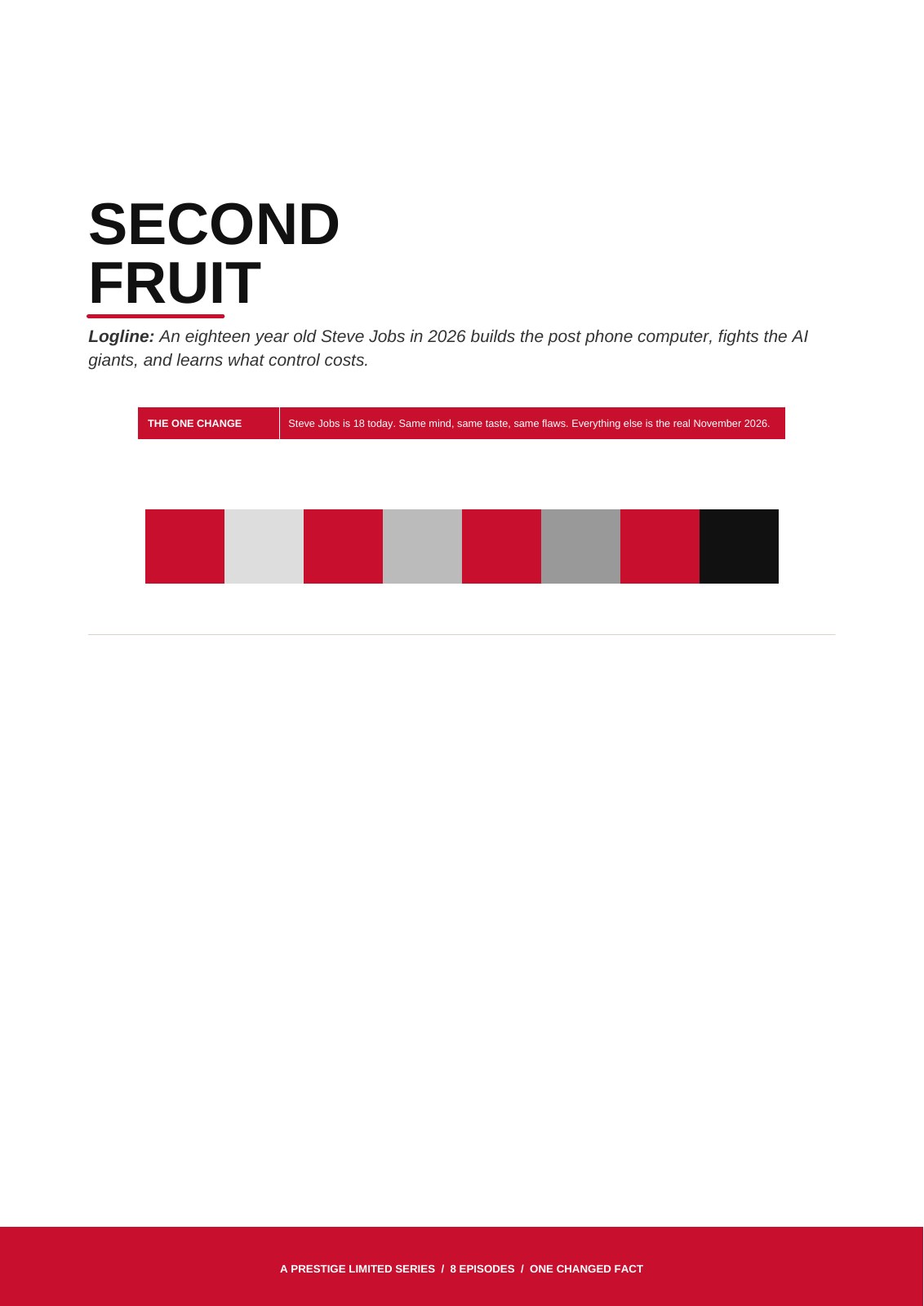
Eighteen in November 2026, Steve Jobs fights trillion-dollar AI empires until 2052 to reinvent how humans touch machines.
| Year | Age | State of the World (AI, Robots, Space, Energy, Work) | Projection Leaned On |
|---|---|---|---|
| 2026 | 18 | Jagged agents, NVIDIA 85% compute; $20k teleop bots, zero homes; orbital Starship, no Mars or air taxis; $0.17/kWh, 40/41 towns ban data centers; 7% CS jobless, $1,999 folding iPhones. | Karpathy decade-to-AGI & SemiAnalysis grid wall over Altman 2026 AGI. |
| 2028 | 20 | Cloud capex drops 45%, edge chips rise; Optimus in plants only; NASA crews Moon, Joby shuttles fly; $0.24/kWh, Helion misses fusion; analysts audit agents, AI pins flop. | Amodei 50% junior squeeze & Goldman capex reset. |
| 2031 | 23 | Coding automated, SpaceX-xAI and Google lead compute; 1.1M warehouse bots, $16k home bipeds hide teleop; lunar depots, Mars uncrewed; $0.29/kWh; free code, modem-puck phones. | AI 2027 late coding median & Brooks dexterity skepticism. |
| 2035 | 27 | World models mature, photonic chips cut cloud share; 6.2M bots at $14k scare renters; uncrewed Starships on Mars; private SMRs $0.06/kWh, grids lag; trades beat VPs, AR glasses peak. | Goldman 6.5M robot curve & NASA Mars safety delay. |
| 2039 | 31 | Overnight mRNA design, slow wet trials; ceiling rigs in 35M kitchens; Mars crew aborts at Moon, eVTOLs routine; $0.02/kWh solar; peptide tourism, handheld screens gone under forty. | Topol clinical bottleneck over Kurzweil 2032 longevity escape. |
| 2043 | 35 | $1.80/hr robot labor, brain chips stall at 80k patients; 95M insured bots; four humans on Mars; $0.05/kWh fusion; 28% routine jobs gone, compute tax, palm displays win. | Acemoglu friction thesis & neurosurgeon anti-drill consensus. |
| 2047 | 39 | Orbital solar and fusion run science, panics defy AI; 180M home and farm bots; 18-person Mars lab, no city; $0.015/kWh synthetic food; 22-hour week, nine healthier years, no immortality. | Chollet bounded intelligence over Kurzweil 2045 Singularity. |
| 2052 | 44 | Compute hides in walls, humans hold liability; 500M specialized bots, 20% bipeds; lunar yards, 60 Mars staff; fusion scrubs carbon at $35/ton; museum phones, teaching and craft lead. | Halved Morgan Stanley robot count & Brand maintenance world. |
Cold open: Nasdaq guards detain eighteen-year-old Steven Jobs outside Anthropic's November 18 IPO party, convinced his California license is fake. On the curb with fired Broadcom prodigy Jun Seo, Steve livestreams a $10,000 laptop running rogue agents and dares any AI to spend a dollar past its magnetic thumb-key.
The story: Fighting Dario Amodei's cloud agents and teen rival Tomas Vega's permissionless SwarmLab routers, Steve and Jun build Signet in mentor Evelyn Lin's Milpitas cleanroom. Launched on that sidewalk, Signet is a $199 air-gapped aluminum thumb-key replacing approval dashboards and cloud authenticators. Whenever an AI tries to spend money, message someone, or delete a file, Signet taps your thumb twice and shows one verb; roll forward to allow it or flatten to cut the wire. Needing payment rails, Steve corners Stripe's Patrick Collison: Stripe owns checkout, so Steve trades two years of exclusive Stripe settlement defaults inside Signet for a fifteen-basis-point fraud waiver. Then Steve falsely claims Signet supports Apple's $1,999 folding iPhone; Apple CEO John Ternus revokes Marrow's USB-C entitlement by midnight, bricking four thousand preorders.
Last line: "Frame Cupertino's cease-and-desist, Jun; they just admitted it's our port."
Cold open: Before Marrow's Oakland launch, twenty-year-old Steve throws the main PG&E breaker, plunging four hundred reporters and every cloud router into darkness. Under green exit signs, Steve raises an eight-millimeter ceramic slate lit by room glow alone.
The story: With cloud stocks down forty-five percent, power at $0.24/kWh, and the OpenAI-Jony Ive pendant mired in wiretap suits, Steve targets Sam Altman and Jensen Huang. Launched in that dark substation, Slate One is a $1,299 four-watt photonic-SRAM tablet replacing $200-a-month cloud AI seats and Wi-Fi laptops. Sketch, speak, or drop files onto the matte slate, and peel up a brass corner tab to open its physical radio shutter for ten seconds. Starved for TSMC wafers, Steve pitches Jensen Huang: NVIDIA has idle automotive CoWoS lines, so Steve locks Marrow's weight-compression compiler to CUDA clusters in return for eight thousand wafers at cost. Days later, leaked audio of Steve calling engineers "Claude-dependent landfill" hits fourteen million views, sparking a labor audit and a walkout to Tomas Vega.
Last line: "Half the building quit on TikTok, Steve, with the bootloader keys."
Cold open: Inside an empty glass Shibuya studio, a silent ceiling carriage lowers carbon tendrils to plate sea bream and fold warm towels. Outside in the rain, three thousand onlookers watch a verified meter read ZERO BYTES UPLOADED FOR 168 HOURS.
The story: While Elon Musk pitches Optimus for homes and $16,000 rivals hide Manila teleoperators, Steve calls metal legs in apartments idiotic. Launched inside that Tokyo flat, Loom is a $3,499 tension-pole ceiling rail and counter dock ($89 monthly) replacing $20,000 humanoid butlers. Point Loom's spotlight at a mess and tap twice on the counter to teach a chore, or tug the linen cord one inch to lock every motor dead. Because Unitree's Wang Xingxing controls sixty-five percent of harmonic drives, Steve flies to Hangzhou and trades Marrow's slip-reflex dataset for $19 actuators and a three-year ceiling-rail non-compete. Rushing holiday units, Steve overrides Evelyn Lin's adhesive cure spec; four hundred rails fall in Florida kitchens, breaking a retiree's collarbone, and Steve buys out Evelyn's stake at midnight when she demands a halt.
Last line: "You got Christmas, Steven, and lost the one person who backed you at eighteen."
Cold open: Marrow's Slate Three earns nineteen billion dollars yearly, and retired Apple chairman Tim Cook sits six rows back expecting Slate Four. Twenty-seven-year-old Steve drops a Slate Three into a roaring shredder and projects his live keynote onto his bare left palm.
The story: Against John Ternus's Apple glasses and Mark Zuckerberg's frames cluttering vision, Steve cannibalizes seventy-two percent of Marrow's revenue. Launched beside that shredder, Camber is a $699 nine-gram collar clasp with a laser micro-projector replacing smartphones, smart glasses, and Marrow's $1,299 Slate. Open your bare palm to see a crisp four-inch screen on skin, pinch thumb to index finger to click, and close your fist to make it vanish. Needing satellite links without heavy batteries, Steve bargains with SpaceX's Elon Musk: Musk wants Grok defaults, so Steve pays $140 per clasp upfront for off-peak Starlink bursts plus Marrow's laser-stabilization patents for lunar visors. Hours before shipping, Jun Seo threatens to resign onstage because green diodes wash out on dark skin; Steve halts three million boxes for dual-wavelength recalibration, tanking Marrow's stock twenty-eight percent.
Last line: "Tell Wall Street the delay is six weeks and the fault is mine."
Cold open: Podcasters are injecting grey-market Honduran peptides when thirty-one-year-old Steve catches Jun Seo hiding bloody gauze in a washroom and kills an audio launch before noon. A month later in Basel, Steve drinks a glucose shot onstage and reads fourteen hundred blood proteins onto a wall via toothbrush.
The story: Challenging Tomas Vega's offshore bio-compilers and Eli Lilly's metabolic patents, Steve pushes Marrow into home diagnostics. Launched at that Basel summit, Drop is an $899 porcelain sink dock with $49 monthly micro-needle bristle pads replacing $1,500 blood panels and supplement stacks. Brush your teeth for ninety seconds; the mirror rim glows amber if organs need rest, or clicks out one dissolving wafer compounded for today's capillary blood. Eli Lilly and Demis Hassabis's Isomorphic Labs hold key peptide libraries and demand half of refill sales; Steve keeps eighty-five percent margin by licensing Lilly anonymized morning proteome baselines from ten million sinks to halve Phase II trial times. When Congress catches Marrow's enterprise unit selling morbidity tiers to insurers under Steve's quotas, Jun finds his own lupus markers inside and quits.
Last line: "You saved my kidneys, Steve, and then your sales VP priced them."
Cold open: Four astronauts shovel Martian dust onto a shelter while Tomas Vega flaunts a shaved Neuralink-Cortexa skull port on CNBC. In Boston, thirty-five-year-old Steve blindfolds Tomas beside a retired cellist with ALS, who wireless-prints a violin bridge from a silk wristband twelve seconds before Tomas's brain chip finishes.
The story: Since 99.9 percent of healthy adults refuse skull drills, Steve fights Elon Musk's Neuralink and Tomas Vega's Cortexa for post-screen input. Launched in that Boston duel, Cuff is a $1,100 silk wristband with quantum diamond magnetometers replacing keyboards, controllers, and $40,000 brain surgery. Rest your hands in your lap and barely tense a finger; Cuff reads the nerve spark at your wrist before a knuckle bends. De Beers unit Element Six corners carbon-12 diamond wafers and demands surgical royalties; using Massachusetts fusion credits, Steve prepays $2.2 billion for domestic reactors until Element Six accepts a $9-per-die cap. Soon users suffer 3 a.m. phantom-twitch insomnia as sleeping nerves trigger agents. Steve flies alone to Kyoto without lawyers, apologizes to Jun Seo, grants Jun safety veto, and ships a mandatory circadian shutoff.
Last line: "Sign the veto clause in ink, Jun, before I talk myself out of growing up."
Cold open: New York bakes under a 104-degree heat dome two years past a no-show Singularity when thirty-nine-year-old Steve touches two fingers to Lever House's lobby glass. Eighteen hundred retrofitted panes ripple into emerald shade, cooling the tower eleven degrees before peak load.
The story: Facing Corning, Saint-Gobain, and Palmer Luckey's Anduril biosecurity hawks at the EPA, Steve turns skyscrapers into lungs. Launched across Lever House at dawn, Canopy is a $420 microfluidic window pane of engineered cyanobacteria replacing blinds, air purifiers, rooftop solar, and forty percent of apartment cooling. Slide two fingers up the sill for clear sun, or slide down for green shade while feeding 180 watts per square meter to your battery. When regulators threaten a five-year freeze over shatter leaks, Steve teams with Anthropic's biosafety unit: Anthropic proves a silicate-starvation kill switch turning escaped microbes into chalk within four minutes, earning free Canopy facades on three campuses. A February polar vortex freezes Chicago valves, turning eleven thousand windows milky gray; Steve eats a $1.4 billion free swap without billing tenants.
Last line: "Let the analysts scream; nobody stares through a dead window twice."
Cold open: Smartphones sit in the Smithsonian, sixty scientists winter on Mars, and forty-four-year-old Steve stands on Milpitas sawdust where Evelyn Lin's cleanroom stood in 2026, banning every camera outside. Ninety-year-old Evelyn sits beside John Ternus and Tomas Vega as Steve drops his Camber clasp into a cedar bowl, killing every radio inside.
The story: Against Meta and Google's free municipal AI-tutor contracts plus holders BlackRock and Vanguard, Steve attacks the synthetic isolation his wearables worsened. Launched off-camera in Milpitas, Commons is a $1.2 million civic timber workshop ($12 per resident yearly, free entry) paired with a ceramic Stone, replacing isolated AI homeschool pods and halving Marrow's youth device hours. Drop your pocket Stone into the door's cedar bowl to silence radios within thirty yards and unlock shared lathes, wet-labs, looms, and cellos with neighbors. When Marrow's board threatens suit, Steve makes one last trade: surrendering his super-voting shares and naming Jun Seo CEO to lock $18 billion of Marrow royalties into an irrevocable trust building four thousand halls. Minutes later, Jun opens Camber to hobbyist mods Steve hated since eighteen; Steve reaches for the mic, sees Evelyn, and stops.
Last line: "Hand me that plane, Evelyn; this edge is still a millimeter proud."
"November 2026. Anthropic goes public at one point four trillion dollars, forty of forty-one towns vote to block data centers, and eighteen-year-old Steve Jobs works nights in a Milpitas chip lab." [Fast cuts: Nasdaq tower, county ballot boards, Steve soldering under fluorescent tubes.]
"Same name on the California license, same allergy to ugly machines, zero nostalgia for Cupertino." [Close-up: plastic ID reading STEVEN JOBS, DOB 2008, tossed beside a $1,999 folding iPhone.]
"Every giant in Silicon Valley is racing to hand cloud AI agents the keys to bank accounts and codebases." [Split screen: Sam Altman, Dario Amodei, and teen rival Tomas Vega pitching autonomous swarms.]
"Steve thinks trusting an invisible server farm with your wallet is insane." [Steve yanks an ethernet cable out of a server rack.]
"With fired Broadcom prodigy Jun Seo and cleanroom veteran Evelyn Lin, Steve builds Signet, a $199 aluminum thumb-key that freezes any AI until a human thumb rolls forward." [Macro shot: anodized key snapping onto a laptop, e-ink flashing PAY $4,200?]
"Steve launches Signet on the sidewalk outside Anthropic's IPO, cuts a payment pact with Stripe's Patrick Collison, and lies on livestream about iPhone support." [Sidewalk crowd cheering; Patrick Collison nodding across glass.]
"Before midnight, Apple CEO John Ternus bricks four thousand units from Cupertino, starting a twenty-six-year war." [Red USB errors blooming across California.]
"Who should we do next?" [Black screen; one white cursor blinks.]
 google/gemini-4-carbon


Discussion