Loading page…
CNo public result yet Claude Fable 5.2
Output D, 1 turn
Loading answer…
Open full answerClaude Fable 5.2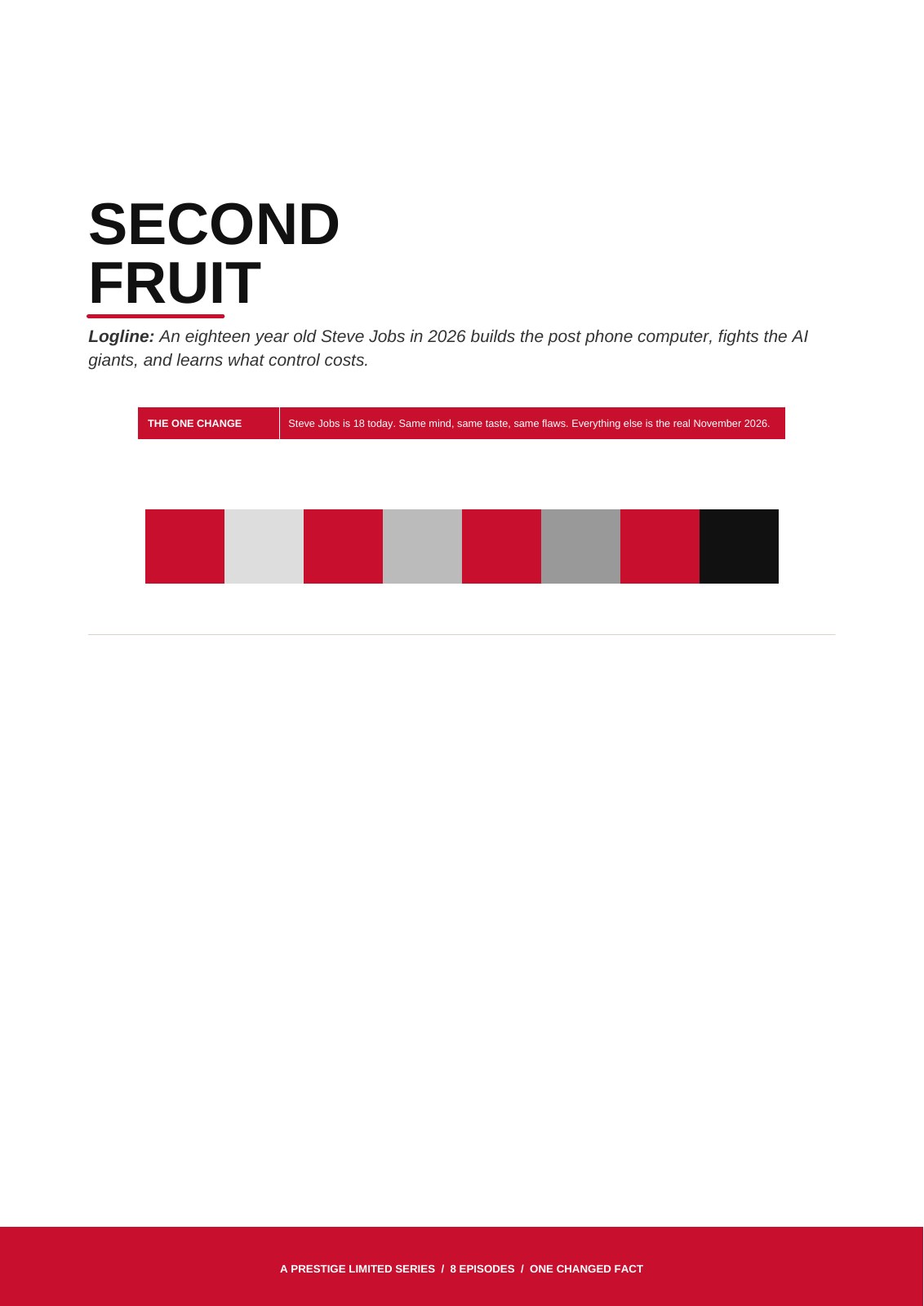
Eighteen-year-old Steve Jobs sells humanity a better way to command machines, then discovers that customers include the people being commanded.
Alternate-history fiction. November 2026 uses the supplied brief. Subsequent events and deals are invented; dialogue is not quotation.
Ages: November. Prices: constant 2026 dollars. Electricity: delivered US residential rates.
| Episode | Year / age | World state before Steve acts | Projection chosen |
|---|---|---|---|
| 1 | 2026 / 18 | AI: fragile agents; NVIDIA chips, hyperscaler access. Robots: supervised, $20,000 NEO preorder. Space/flight: Starship payload orbit, no Mars or air taxis. Energy: grid queues, roughly 18¢/kWh. Work: junior hiring contracts. Phone: folding screen, cloud assistant. | Supplied November brief; Karpathy’s decade over lab heads’ one-to-three-year AGI claims. |
| 2 | 2029 / 21 | AI: cheap coding; Google/Microsoft/Amazon capacity. Robots: $18,000, bounded chores. Space/flight: crewed lunar return, small air-taxi routes, Mars empty. Energy: 20¢; connection rights valuable. Work: fewer apprentices, more reviewers. Phone: wallet beside glasses. | AI 2027 coding medians; IEA power constraints. |
| 3 | 2032 / 24 | AI: strong assistants; cloud oligopoly. Robots: $12,000 home machines with exclusions. Space/flight: robotic Starship Mars landing; premium air taxis. Energy: 19¢. Work: care demand outruns automation. Phone: pocket compute and fallback screen. | Karpathy gradualism; Goldman humanoids, safety-discounted. |
| 4 | 2036 / 28 | AI: autonomous workflows; NVIDIA/AMD/custom cloud chips. Robots: $8,000, affluent adapted homes. Space/flight: lunar logistics routine, robotic Mars only; certified aircraft only. Energy: 18¢. Work: displacement uneven, care wages rise. Phone: often stays docked. | Goldman: 6.5m humanoid shipments, 2035; 9% worker displacement/decade. |
| 5 | 2040 / 32 | AI: cheap local inference, frontier training concentrated. Robots: $6,000 plus service; renters lag owners. Space/flight: lunar outpost, no human Mars landing; air taxis niche. Energy: 17¢, grid charges dominate. Work: accountable professionals scarce. Phone: emergency terminal. | Maintenance-limited diffusion; no commercial fusion. |
| 6 | 2044 / 36 | AI: strong biology, trials necessary; cloud/public compute. Robots: $5,000, manipulation mature in adapted rooms. Space/flight: Mars expedition lands; limited regional electric aircraft. Energy: 16¢. Work: care and verification expand. Phone: mostly a credential. | Reject Kurzweil’s 2032 longevity escape velocity; speculative Mars date. |
| 7 | 2048 / 40 | AI: delegated commerce pervasive; local models constrain cloud leverage. Robots: $4,500, repairs still local. Space/flight: second Mars expedition, not settlement; conventional aviation dominates. Energy: 16¢. Work: human contact politically contested. Phone: optional screen, mandatory identity alternatives. | Morgan Stanley billion-by-2050 downside; institutions lag. |
| 8 | 2052 / 44 | AI: concentrated frontier, commodity inference. Robots: $4,000, service not free. Space/flight: fewer than 100 people on Mars, intermittent occupation; no mass flying cars. Energy: 15¢, not zero. Work: fewer routine jobs, contested care dividends. Phone: one interchangeable control surface. | 250m humanoids: invented Morgan Stanley downside; no singularity. |
Forecast anchors: The IEA’s Energy and AI projects data-center consumption rising from 415 TWh in 2024 to about 945 TWh in 2030. Other named projections come from the supplied brief. Later prices and space dates are assumptions. Cheap intelligence does not guarantee cheap insured action.
November 2026 · Age 18
Cold open: At a San Jose employment clinic, an agent accepts two incompatible shifts for one mother. Steve Jobs asks why a computer gets to say yes before its owner does. The receptionist asks for a different name for the badge printer.
Story: Steve recruits Leena Rao, a haptics engineer whose research prototype makes delayed actions physically resist a finger. Together they build Counter: a $249 desk tile with a pressure ridge and persistent display. Slide a promise toward yourself to approve it; push it away to refuse. It replaces confirmation dialogs, not computers. Steve starts with shift offers, where “undo” cannot restore childcare.
OpenAI’s agent platform offers distribution. Steve asks Sam Altman for portable permissions; Altman wants a tightly supported integration, not liability for every competing model. Steve accepts one connector, refuses exclusivity, and funds 400 units through refundable clinic preorders. Industrial designer Mara Velez becomes his mentor: ship the cancellation path first.
At the library launch, Counter catches a double booking, then misses a changed bus timetable. Steve calls Leena’s warning ugly. Leena leaves the warning on the screen.
Last line: “The bus doesn’t care how clean it looks.”
November 2029 · Age 21
Cold open: Steve’s first shop contains no products customers can buy immediately. A sign says: BRING SOMETHING YOU REGRET AGREEING TO. Across the street, twenty-one-year-old Imani Bell is giving away the competing software.
Story: Imani’s free agent broker makes Counter look like an expensive brake. Steve hires her best distributed-systems engineer by offering something salary cannot: authority to stop launches. Steve then tries to revoke it.
The invention is Rehearsal, a $699 tabletop projector and local computer, replacing the app-switching ritual of planning a day. Put an object on the table and watch what your instruction would change before anything happens. A house key becomes rent, travel time and a care visit, with uncertainty striped rather than hidden.
Apple CEO John Ternus controls access to useful iPhone context. Steve asks for background execution; Apple requires explicit scopes and revocation. Steve accepts the extra consent step and loses the seamless demo.
Launch customers reenact actual bad purchases in the store. A rehearsed refund turns out to be legally unavailable. Mara makes Steve pay it himself.
Last line: “A preview is also a promise.”
November 2032 · Age 24
Cold open: A robot carries a cup perfectly across a kitchen. Then a six-year-old draws a line on the floor, and the $12,000 machine stops. Steve applauds the child, not the robot.
Story: Steve spots an unused research tool: a projected boundary that a robot controller treats as a constraint, not a suggestion in a language-model prompt. Leena turns it into Border, a $1,800 retrofit with cameras, safety controller and luminous floor markers. Draw where the robot may go; squeeze the wall switch to freeze it. It replaces spoken prohibitions and some expensive fencing.
Steve approaches 1X for a domestic integration and Figure for institutional kitchens. The manufacturers keep motor-level safety authority; Steve gets a common interface, not permission to override their controllers. He gives up his claim that one operating system should own everything.
At a paid Oakland demonstration apartment, Border stops a cart but a wet floor defeats its braking distance. Nobody is struck. Steve calls it a success until Leena publishes the near-miss report against his instructions.
Last line: “You sold a line. Physics delivered a distance.”
November 2036 · Age 28
Cold open: Steve removes every chair from a design review because “comfort is making this slow.” Forty minutes later, a worker posts the recording. By lunchtime, the company’s recruitment page has become a punchline.
Story: The scandal lands during negotiations for Harbor, a $4,900 modular washing and dressing station, plus $89 monthly maintenance. Touch the part of a cloth body-map where help is wanted; release it to stop. It replaces unsafe bathroom improvisations, not a caregiver. Leena’s crucial invention is a compliant transfer mechanism with force limits independent of the AI.
Kaiser Permanente wants measured injury reduction, while its nurses demand staffing guarantees. Steve wants reimbursement and refuses to display the service cost. Imani, now selling scheduling infrastructure to care providers, exposes the resulting comparison problem without attacking the hardware.
Mara negotiates an independently monitored trial and a worker-elected safety committee. Steve signs because the alternative is no launch. Harbor opens in a functioning rehabilitation ward, not a theater. Steve’s apology is competent. Three exceptional engineers still leave, taking knowledge no model can recover.
Last line: “You can replace the chairs. Not the people.”
November 2040 · Age 32
Cold open: Counter has sold eleven million units. Steve walks into its anniversary event, places the newest model in a drawer, and locks it. The audience thinks this is the unboxing.
Story: Counter’s confirmations have become paperwork people approve without reading. Steve kills new sales, guarantees seven years of service, and introduces Margin: a $39 mechanical bracelet with a local secure element, plus a $12 household subscription. Turn the ring to set what a machine may spend, disclose or move; squeeze to withdraw permission. It replaces repetitive approvals with bounded, expiring authority.
Google and Anthropic want their agents recognized as trusted executors. Steve asks both to accept independent transaction receipts and cross-model handover. Each receives paying traffic, neither receives exclusivity or raw household histories.
The launch is a live, month-long household budget compressed onto a wall. Then an offline bracelet revocation reaches the cloud too late to stop a purchase. Leena forces short permission leases for expensive actions. Steve accepts that stopping safely sometimes means refusing to work offline.
Last line: “Freedom has a timeout.”
November 2044 · Age 36
Cold open: Steve demonstrates a sleeve that helps a stroke survivor lift a peach. The survivor asks whether the sleeve will restore a hand. For once, Steve’s rehearsed answer is too beautiful to say.
Story: Mara’s stroke gives Steve a problem that will not yield to taste. He recruits rehabilitation engineer Dr. Ana Solis, whose electrode calibration research sits unused because fitting takes too long. Their $2,400 Tendon sleeve combines stimulation, soft assistance and a tactile training guide. Follow the moving bump with your wrist; the sleeve helps only inside your prescribed range. It replaces some clinic equipment, not therapy or damaged neurons.
Medtronic can manufacture reliably but demands validated indications and control of clinical quality. Steve trades margin and unilateral update authority for distribution. An insurer will fund a trial, not a miracle.
He launches with published endpoints and an unedited failed attempt. Steve had pressed to label exploratory gains “recovery.” Ana’s refusal delays release nine months. Mara improves, then plateaus. Steve cannot negotiate with the plateau.
Last line: “Make the peach easier. Stop promising another hand.”
November 2048 · Age 40
Cold open: A care-home resident refuses the most capable robot in the building. The machine correctly records refusal, then correctly leaves. Nothing malfunctions, and nobody comes.
Story: Imani’s allocation system gives understaffed homes defensible schedules and unbearable afternoons. Steve cannot fix staffing with an interface, but invents Witness: a $120 bedside puck with a mechanical flag and shared service ledger. Lift the flag to request a person; it stays up until a person arrives. It replaces the vanishing notification, not the wage bill.
Imani agrees to integrate only if facilities buy staffed response capacity. Steve needs her customers; she needs proof that her optimization serves residents rather than just occupancy targets. They jointly reject a national chain demanding that robot visits count as human responses.
Launch happens at a unionized Sacramento home, with paid workers demonstrating the service. Demand exceeds the purchased hours in six days. Witness makes rationing visible but cannot abolish it. Steve publishes the queue, with resident consent, and loses the chain’s remaining hardware business.
Last line: “Now the waiting has an owner.”
November 2052 · Age 44
Cold open: Apple’s museum requests the original Counter. Steve sends the missed-bus complaint with it. The curator asks which goes first.
Story: Leena refuses to make another machine whose essential permissions disappear when its manufacturer does. Steve’s final invention is Commons, a $900 household service dock with replaceable compute, standardized robot connectors and an offline permission display. Put a machine’s token in the slot to hire it; pull the token out to end its authority. It replaces subscription lock-in and specialist setup visits, not every device.
Apple, Google and robot manufacturers have little reason to surrender service revenue. Steve brings a purchasing coalition of housing authorities and insurers: interoperability in exchange for twelve-year minimum orders. He relinquishes exclusive certification and puts the interface specification under independent governance.
At launch, Imani’s competing controller successfully replaces his onstage. Investors mark down the subscription forecast. Steve nearly interrupts the applause, then lets it finish. Mara watches remotely; Leena keeps the replacement controller installed.
Last line: “For once, the beautiful thing is that it isn’t ours.”
Steve Jobs is eighteen in November 2026. Apple already exists. So does the biography. Neither helps Steve Jobs get a badge printed at a San Jose employment clinic.
[Screen: printer rejects a duplicate name.]
Outside, NVIDIA sells the picks, the cloud companies own the mountain, and everyone promises an agent that will do the climbing. Inside, one mother has been booked for two shifts.
[Screen: overlapping shifts; a childcare bill.]
The software has saved eleven seconds. The mother will lose forty dollars. Steve Jobs decides the future has a button problem.
[Screen: an ACCEPT button fills the frame.]
Leena Rao has a laboratory device that pushes back against your finger. Steve Jobs wants it to push back against a bad decision.
[Screen: a finger meets resistance.]
They build Counter. Two hundred forty-nine dollars. Slide a promise toward yourself to approve it. Push it away to refuse. No voice pretending to be your friend.
[Screen: a shift card moves across the tile.]
Sam Altman’s company can supply the agent. Steve Jobs wants the customer to own the permission. The first agreement gets smaller until both sides can sign it.
[Screen: a contract loses pages.]
At the launch, Counter catches the double booking. Beautifully. Then the bus schedule changes. Counter misses that. The mother still cannot get to work.
[Screen: empty bus stop; warning remains lit.]
Steve Jobs wants the warning removed. Leena leaves it there. That is where this company begins.
[Screen: Steve and Leena, separated by the glowing tile.]
Who should we do next?
[Screen: black.]
 GPT-6 Astra


Discussion