Loading page…
ANo public result yet Claude Opus 5.5
CNo public result yetClaude Fable 5.2
Claude Fable 5.2

Output G, 1 turn
Loading answer…
Open full answerClaude Opus 5.5Claude Fable 5.2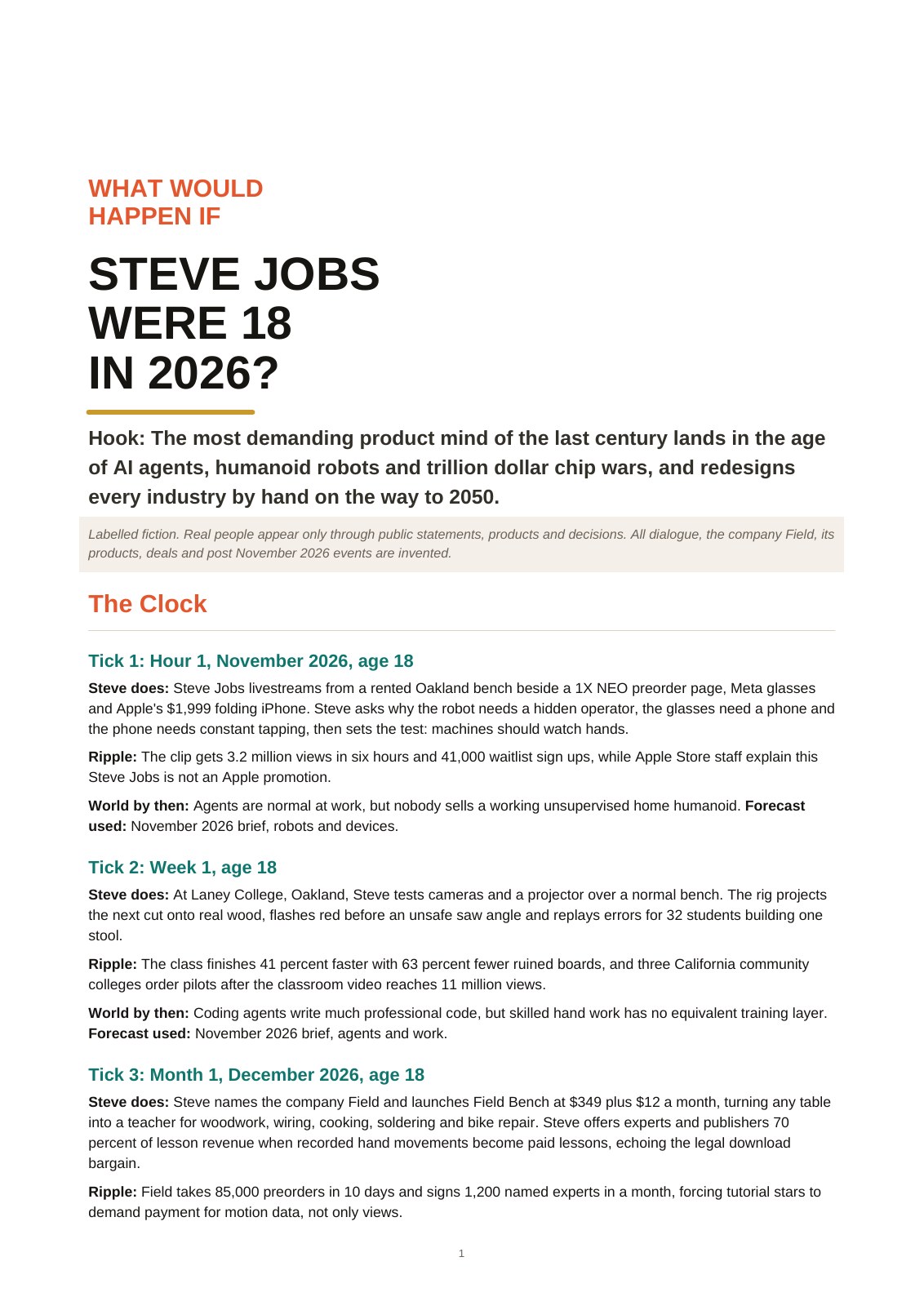
Hook: An 18-year-old with the most famous name in technology starts with a rented robot, a motel on Story Road and no money, and by 2050 owns three interfaces nobody can go around: touch, power and the body.
Hour 1. Age 18. Steve walks into the Sunset Motel on Story Road and offers to turn all 34 rooms tonight for free if he may film it. He has a rented Unitree G1 and a teenager in a Hyundai who is about to be the robot. The owner reads the ID: "And I'm Tim Cook." Ripple: 34 rooms in 4 hours 10 minutes instead of 9. Steve posts the invoice: $22 an hour, $4.10 of electricity. World: No home humanoid works unsupervised; Unitree frames start near $5,000.
Day 1. Age 18. The G1 takes out a bathroom door, so Steve stops making it smart and starts making it bearable. Choreography goes on a whiteboard: knock first, never pass behind a guest, hands visible, 40 minutes a room. He hires the three laid-off cleaners at $26 an hour to supervise. Ripple: The invoice video passes 41 million views in six days; eleven motels sign at $25 a room. World: Entry-level software jobs are down about 20% since 2022.
Week 1. Age 18. Steve names the company FIG, ignores 200 investor emails, and drives to Stanford to watch a postdoc press a rubber fingertip that feels paper slipping out of a grip. No grant in six years: touch is not a market. He buys it for $180,000 and 4%. Ripple: Dr. Yuki Tanabe becomes employee two; within three years every robot hand is measured against FIG's fingertip. World: Goldman expects about 890,000 humanoids shipped by 2030; hands are the unsolved part.
Month 1. Age 18. Steve turns down Marc Andreessen twice and raises $9M from two hotel REITs on terms nobody else would take: no board seat, FIG owns every process. The first launch is a number: 300 hotel owners in a warehouse, one slide, the cost of a turned room per city per year. Ripple: 1,900 rooms a night in four metros, $1.4M a month. UNITE HERE files; Steve hires 40 members at $34 an hour. World: Anthropic's IPO is reported to price this month near $1.4 trillion.
Month 6. Age 18. Steve needs a brain that fits in 4 watts and one in the cloud for the hard 2%. He walks into OpenAI with one page: FIG puts OpenAI's agents in 40,000 rooms a night, OpenAI gets the telemetry, FIG keeps the customer and pays per room, not per token. Ripple: FIG hits a $310M run rate and OpenAI's agents get their first body count: 61,000 rooms a night. World: 90% of professional developers use coding agents weekly; agents are normal, bodies are not.
Year 1. Age 19 (late 2027). Compute has to sit next to the work and the grid queue runs seven years. Steve buys six dead mall anchors for $41M, puts gas engines and batteries on the parking, racks NVIDIA silicon inside, and sells hospitals thinking in nine days. Nobody ballots against a data center in a Sears. Ripple: 210 MW switch on without entering an interconnection queue; three utilities copy it and mall REITs rally 22%. World: 7 GW of US data centers were delayed in 2026 for lack of grid connection.
Year 2. Age 20 (2028). The fingertip model has to run on the robot, not in a mall, so Steve makes a chip. He cannot beat NVIDIA at training and does not try: 4 watts, one small model, taped out at Broadcom. The deal costs a royalty on every unit and buys 18 months. Ripple: Compute cost per room falls 71%. Touch 1 ships in 2029 at $38, including inside two rivals' robots: Steve wanted the standard, not the margin. World: NVIDIA supplies 80 to 90% of AI accelerators at about $4.1 trillion.
Year 3. Age 21 (2029). Steve kills Room. With local touch the machine can do a room with nobody steering, so on a Tuesday he shuts the teleoperation floor and ships Hand at $11,900, or $299 a month. 11,400 operators lose the job FIG gave them; 6,900 come back at higher pay; the rest get nine months and a $40M credit Steve brags about. Ripple: Revenue doubles to $4.1B while headcount falls 38%. At a House hearing Steve spends the last 12 minutes demoing the machine. World: Tesla promised Optimus deliveries around end-2027; 1X NEO is $20,000 with humans inside.
Year 4. Age 22 (2030). Elon Musk jumped a "flying" Roadster off a ramp and the FAA said it is not an aircraft. Steve buys 300 garage and mall roofs, spends $700M permitting each as a landing site with a 60-second turnaround, then charges the aircraft makers: "Elon jumped a car off a ramp. I own the ramp." Ripple: When Joby carries passengers in 2031 it lands on a FIG pad 84% of the time at $41 a landing: $1.1B before FIG flies anybody. World: No certified air taxis in 2026; Joby and Archer awaited the FAA.
2031. Age 23. Apple ships it. On a stage Steve would have designed, John Ternus launches a folding iPhone with hands, a home machine on FIG's open touch spec, and a patch. The engineer presenting it is Yuki Tanabe, who left FIG in 2028 after Steve humiliated her over a tape-out slip. Apple offers $190B; Steve says no. Ripple: FIG loses $61B in two days, down 38%; Apple sells 14 million home machines in a quarter. Eleven days later Steve buys 1,100 draw sites for $3.2B. World: Apple sells a $1,999 folding iPhone; the new Siri reportedly leans on Google.
2032. Age 24. The clinics are not a healthcare bet, they are the store. Steve builds One Number: a patch, a reader and 1,100 sites that reduce your physiology to one digit a morning plus one sentence. He refuses to sell longevity: "we are not selling you years." The FDA holds it 19 months after Steve fires the regulatory lead for calling a deadline aspirational. Ripple: 41 million members by end-2033 at $19 a month. Time from abnormal marker to appointment falls from 34 days to 3. World: Neuralink has 20-odd patients; Kurzweil expects longevity escape velocity around 2032.
2035. Age 27. Steve ships the Box upward: a container of FIG compute, because the sun does not set and there are no voters. He negotiates Starship capacity to $1,900 a kilogram by playing two launch providers against each other where only one was invited. He promises the constellation in 14 months; it takes four years and $2.2B. Ripple: 4.2 GW of orbital compute by 2038 at $0.031 a kWh. The first off-world thing that is not a flag is a FIG rack. World: Starship reached orbit with a payload in Sept 2026 but is not reusable.
2040. Age 32. 260 million continuous bodies is an instrument nobody has had. Steve trades the stream to Isomorphic Labs and Xaira for first rights and one clause: every trial arm runs on FIG data and every failure gets published. An open EU consortium then ships a rival record with 190 million members and beats FIG on outcomes in two cancers. Steve frames their poster behind his desk. Ripple: Time to first signal on a molecule falls from four years to eleven months; three therapies reach patients that would have died in Phase II. World: Morgan Stanley projects about a billion humanoids by 2050.
2045. Age 37. Governments will not pay and the market will not price it honestly, so Steve does what Apple, Google and NVIDIA cannot: he makes the touch model, the One Number record and pad scheduling free to every public health system on Earth, forever. FIG becomes the only company trusted to hold records it promised never to sell. Ripple: Revenue falls 22% while 1.4 billion people are covered in 30 months. NVIDIA's robotics line dips 6% and Jensen sends a bottle with no note. World: Kurzweil's singularity year, 2045; the fight is over accountability, not intelligence.
2050. Age 42. Steve ships one last thing: a machine you talk to during your final six months. No subscription, one job: to tell you the truth about your own body at 3 a.m. and refuse to lie to keep you calm. Steve still declines to explain the difference between himself and the dead man. Asked if better people would have got there faster: "I had the best people alive at every job. I was the problem and I was the reason." Ripple: FIG loses money on all 88 million units. The first child born in a FIG hospital on the Moon gets one at birth. World: A billion humanoids is roughly real; every interface anyone uses came from a motel.
ALTMAN: You clean motel rooms. We are building the thing that ends labor. STEVE: You have ended three org charts and shipped a logo. ALTMAN: AGI internally by the end of this year. By our own definition. STEVE: "By our own definition" is doing all the work in that sentence. ALTMAN: We cancelled a model for lying. Name one other company that killed its own product for being dishonest. STEVE: Name one other company that had to. ALTMAN: A dozen of my best people walked this year and the run rate still doubled. STEVE: They walked because they saw what you intend to do with it. ALTMAN: You want my model inside your robot for free. STEVE: I want your model where there are hands. You have a brain in a jar and a $1.25 trillion valuation on the jar. ALTMAN: And you have forty thousand rooms and no intelligence of your own. STEVE: Correct. I have always rented the brain and owned the moment it touches the world. Ask Microsoft.
Outcome: a truce. Agents ship inside FIG rooms at a price per room, no board seats. FIG gets a brain in Month 6; OpenAI gets distribution.
JENSEN: Everybody wants allocation. Why am I in a Denny's about it. STEVE: Because I am the only one who will tell you what it is for. Nice jacket. I respect a uniform. JENSEN: NVIDIA is worth four trillion dollars. What is FIG worth? STEVE: Less than your Tuesday. I am here about wafers. JENSEN: I founded this company at a Denny's and got told no by people with a lot more than you. STEVE: For thirty years you have sold shovels to everybody digging. I am the only one here not digging. JENSEN: You are the only one here who cannot make a chip. STEVE: True. I made four things people could not live without, all of them by renting the smartest person in the building. You are that person. JENSEN: So you open-source the fingertip and charge me for the nerve. STEVE: I am making CUDA the language of touch. You should be sending me a jacket.
Outcome: a deal: three years of allocation at a fixed price for a royalty on every edge chip. Touch 1 ships 18 months early.
TERNUS: You are early. We are on time. STEVE: You are on time for something I finished four years ago. TERNUS: You published the fingertip spec. We read it. That is what publishing means. STEVE: I published it so the world would build to it. You built to it so the world would buy you. TERNUS: You called our folding phone a hinge with a subscription. STEVE: It is a hinge with a subscription. TERNUS: You drove Yuki Tanabe out over nine days on a tape-out, in front of her floor. She is standing behind me. STEVE: Then thank me. I gave her the problem and the deadline. TERNUS: You gave her an audience for her failure. One hundred ninety billion, and you keep your name off it. STEVE: That is the whole argument and you just won it. No.
Outcome: a loss. Steve keeps the name, refuses $190B, and watches $61B leave in two days. FIG quits consumer hardware for six years and buys clinics.
HOUR 1. "Steve Jobs is 18, broke, and standing in a 34-room motel in San Jose with a rented Chinese robot and a teenager in the parking lot steering it." We see: shaky hallway footage, a Hyundai door open.
WEEK 1. "Forty-one million people watch the invoice. Not the robot. The invoice." We see: a receipt, $4.10 circled in red.
YEAR 2. "Steve walks into a Denny's and asks Jensen Huang for wafers." JENSEN HUANG: "You cannot make a chip." STEVE: "No. But you can." We see: a signature on a napkin.
YEAR 3. "Steve kills a billion-dollar service on a Tuesday and sends 11,400 people home." We see: a one-page letter, a warehouse going quiet.
2031. "Apple ships the machine Steve finished four years ago, and the engineer on stage is the one Steve drove out." We see: a keynote, a folding phone, a chart falling 38%.
2032. "So Steve buys 1,100 clinics and turns the human body into one number." We see: a patch on an arm, a 7 on a screen.
2045. "Then Steve gives the whole thing away, free, to every public health system on Earth." We see: a map lighting up.
2050. "The last product tells you the truth about your own body at 3 a.m. It loses money on every unit." We see: a dark room, one small light, no logo.
"Who should we do next?" We see: black.
Fiction. Real companies and real public statements, invented events. Steve Jobs died in 2011; none of this happened.
 Qwen3.8 Max Prime

Discussion