Loading page…
ANo public result yet Claude Opus 5.5
CNo public result yetClaude Fable 5.2
Claude Fable 5.2Output D, 1 turn
Loading answer…
Open full answerClaude Opus 5.5Claude Fable 5.2Loading…
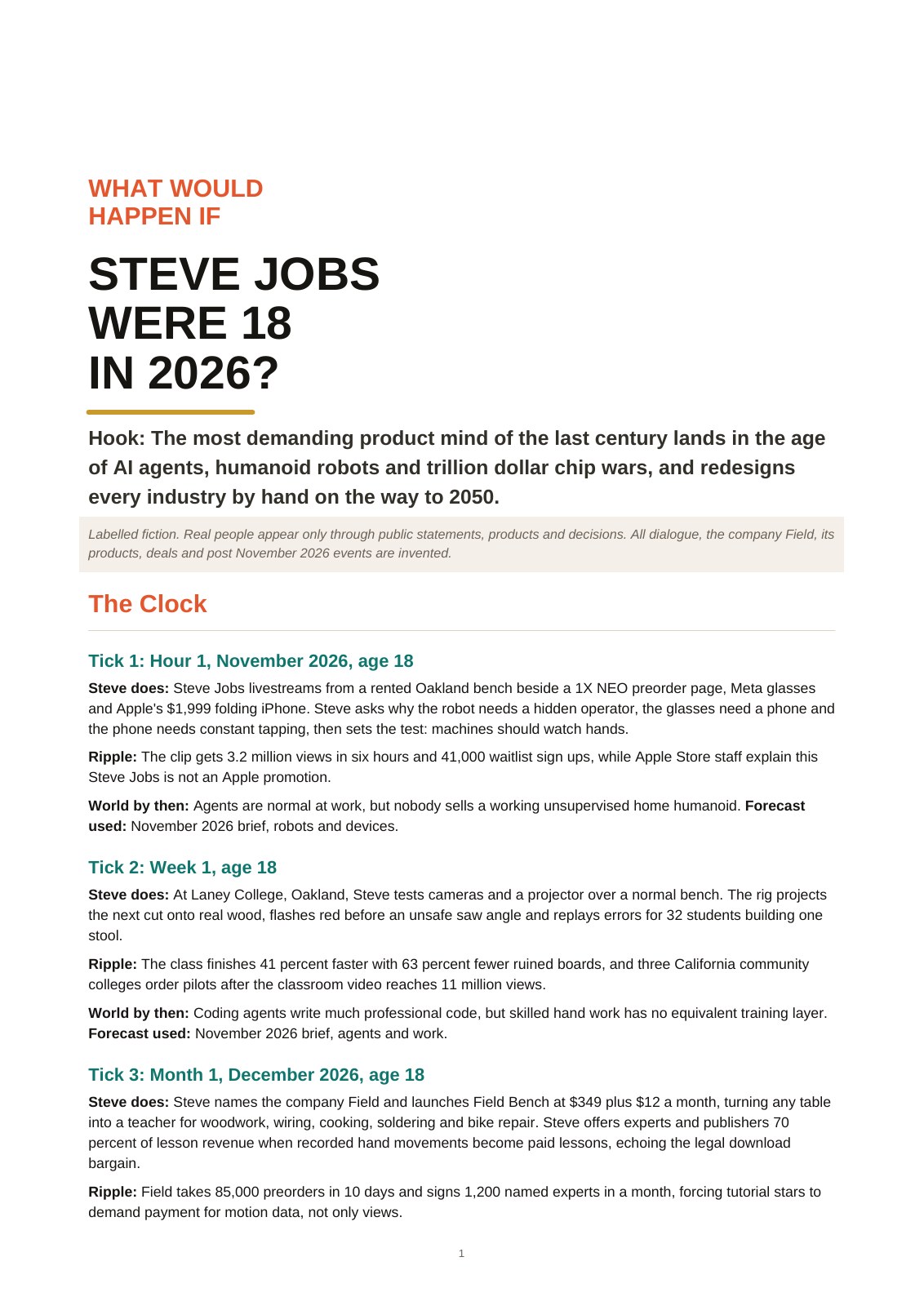
Hook: Steve teaches a robot to set one beautiful table, then discovers the hardest thing to automate is Steve Jobs.
Labelled speculative fiction. The supplied November 2026 brief is the starting scenario, not independently verified news. Products, dialogue, deals and outcomes are invented; forecasts are not guarantees. Later-year ticks occur in November.
Steve does: Steve watches Musk’s Roadster ramp jump, then a home-robot demonstration requiring a remote human. “We’ve automated the stunt driver and outsourced picking up a sock.” Steve sketches a different interface: show a machine the finished room, not a paragraph describing chores.
Ripple: Steve recruits 2 unemployed computing graduates to test whether machines can work backward from a photograph. One asks whether the name is a LinkedIn tactic.
World / forecast: Agents are common; unsupervised home humanoids are not. AI 2027’s authors put median fully automated coding dates in 2028–2032, not tonight.
Steve does: In a rented Oakland community room, Steve stages three dinner tables and photographs every movement between them. The prototype, Scene, lets someone drag real objects around a photograph of their room; a translucent rehearsal shows the result before anything moves. The founders perform the robot motions themselves.
Ripple: Of 12 proposed arrangements, 7 fail because chairs block passage or objects cannot be grasped. The demo gets uglier and the company gets its first useful dataset: attractive arrangements that physics will actually permit.
World / forecast: Coding assistance is abundant, physical competence scarce. The AI 2027 coding forecast does not imply automated household labor.
Steve does: Steve finds the missing ingredient in published robot-learning research: policies that can imitate demonstrations, trapped inside laboratory setups. Steve pitches Chelsea Finn a paid technical review, not a celebrity cofounder announcement; the review’s brutal verdict is that Scene needs a bounded workplace. Steve secures a $2 million seed round from Khosla Ventures against a restaurant pilot and hires a manipulation specialist, a theater movement director and a safety engineer.
Ripple: The team chooses empty dining rooms between services, not occupied homes. Investors wanted a billion humanoids; Steve offers 24 plates and an empty floor.
World / forecast: Factory robots lead household robots. Goldman Sachs’s 2035 humanoid outlook supports a growing supplier base, not universal dexterity.
Steve does: Scene ships in 10 Bay Area restaurants: $299 a month, initially guiding human crews through visual rehearsals. Steve pairs it with a leased industrial arm on a wheeled base inside a restricted work zone, using OpenAI for language and local code for motion limits. Sam Altman wants a broader agent partnership; Steve wants interchangeable intelligence. Face-off 1 happens here.
Ripple: Reset time falls from 40 minutes to 29 in the pilot, but camera occlusion erases the gain on crowded nights. The OpenAI deal caps inference spending and permits rival models, making the next product economically possible.
World / forecast: Better agents, still imperfect robots. AI 2027’s 2028–2032 range justifies improving planning, not removing safety barriers.
Steve does: Steve launches Cast, a $24,000 wheeled, two-armed restaurant robot, with Scene, installation, washable grippers and a repair plan. Customers move ghost furniture in a live room image; Cast rehearses, requests approval and works only inside a cleared zone. Steve rejects a human-shaped head: “The dishwasher doesn’t need to look grateful.”
Ripple: The first 100 customers buy a reset service, not an electronic employee. Stewards become supervisors, but several restaurants cut paid closing hours: Steve has improved a workflow and reduced someone’s rent money.
World / forecast: Assume commercial manipulation improves before home autonomy. Goldman Sachs’s humanoid forecasts are a component-cost proxy; Cast itself is not humanoid.
Steve does: To make Cast quieter, Steve humiliates the safety lead over a bulky obstruction sensor and orders its removal before validation. A trial machine consequently misses a service trolley and crushes it; nobody is injured, but the lead quits and publishes the documented dispute. Steve recalls all 600 units, restores the sensor and gives an independent safety committee binding stop-ship authority.
Ripple: The recall costs $11 million and nine months of sales. An insurer makes reinstatement conditional on those independent controls, so Steve cannot simply charm the board into reversing them.
World / forecast: More deployed robots mean more exposure to mundane failure. Goldman Sachs’s rising shipment trajectory increases the stakes, not reliability by decree.
Steve does: The recall reveals another defect: too much perception depends on remote compute. Steve recruits a chip team to build Hem, a local vision-and-motion module, with Broadcom design services and TSMC fabrication; outside financing pays the tooling bill. Jensen Huang refuses Steve’s fantasy price for the NVIDIA systems still needed to train it. Face-off 2 happens here.
Ripple: A revised training contract and a $140 million chip program cut measured network-dependent pauses by 80% on restaurant tasks. Steve moves flexible training jobs into contracted off-peak capacity instead of promising a fusion-powered campus.
World / forecast: Electricity constrains expansion. The IEA projects roughly 945 TWh of annual data-center electricity demand in 2030; Microsoft’s Helion timetable is not a bankable substitute.
Steve does: Steve kills new sales of Cast, now the bestseller, while guaranteeing seven more years of parts. Its replacement is Stage: washable furniture, constrained robot tracks, embedded sensing and Scene, sold as one room rather than one increasingly talented humanoid. Steve hires a former IKEA manufacturing leader and opens a working restaurant showroom where customers eat the demonstration.
Ripple: A $79,000 installation can reset 40 seats in 8 minutes under specified conditions, without a humanoid squeezing between diners. Cast owners rage, and 18% of pending orders cancel; competitors inherit them while Steve bets on a smaller, more dependable market.
World / forecast: AI 2027’s upper coding median has arrived in this scenario. Better software makes integration cheaper, not kitchen remodeling free.
Steve does: Restaurant customers ask for accessible boarding at the curb, where robotaxis still cannot rearrange the world for passengers. Steve builds Passage, a wheelchair-accessible transfer bay combining a powered platform, canopy, vehicle authentication and a visible boarding rehearsal. Steve first approaches Tesla, then uses a nonexclusive Waymo pilot as leverage. Face-off 3 happens here.
Ripple: A 200-bay pilot joins buildings to compatible vehicles without pretending every car has the same doors. Tesla accepts an interoperability trial, not an exclusive fleet deal; cities require a mechanical fallback and a human-call option.
World / forecast: Assume geofenced autonomy expands, not universal self-driving. Goldman Sachs’s robot growth forecast supports cheaper handling hardware; the user brief’s Waymo footprint anchors the transport extrapolation.
Steve does: Passage exposes the next interface problem: some passengers cannot point, speak clearly or use a touchscreen. Steve acquires licensed university research and develops Thread, a surface-muscle cuff that learns a few deliberate gestures, with tactile confirmation and a separate cancel gesture. A controlled study finds that Steve’s beautiful one-day calibration promise fails for 31% of participants; independent clinical leadership gets authority over indications and launch claims.
Ripple: Thread ships first as an accessibility controller after the required regulatory reviews, at $1,900 plus fitting. Steve’s insistence on a seamless body interface costs two years and $70 million before Steve accepts that individual bodies are not manufacturing defects.
World / forecast: Assistive interfaces can advance without rejuvenation. Kurzweil’s circa-2032 longevity-escape forecast is explicitly not assumed to have come true.
Steve does: NASA contractors want Scene’s rehearsal interface for delayed communication and gloved work; Steve refuses to sell a consumer restaurant kit with a space sticker. Habitat becomes a hardened, offline workbench with captive tools, bounded robotic assistance and a full-size ground twin. SpaceX supplies contracted cargo transport; Steve’s company supplies the box, software, training and replacement inventory.
Ripple: The first lunar customer buys 2 workbenches for $12 million, excluding launch. A small crew gets repeatable maintenance workflows, while terrestrial customers inherit better offline recovery instead of a souvenir Moon app.
World / forecast: Assume a small lunar outpost, conditional on transport progress. Musk’s lunar-city aspiration and NASA’s 2028-or-later landing target are direction markers, not proof of a city.
Steve does: Hospitals request Thread plus Stage for rehabilitation rooms, but Steve refuses a hospital’s independently certified replacement cuff because its appearance breaks the system’s visual language. A procurement coalition freezes $430 million of prospective orders and buys modular rivals instead. Steve loses, then signs an interoperability covenant covering certified controls, repair access and data export.
Ripple: Three rival cuff suppliers gain access to the installed system, and prices fall 22% in the next tender. The whole-product company must become a whole-experience company without owning every component.
World / forecast: Bodies remain variable and institutions retain purchasing power. Kurzweil’s 2045 singularity date is a contrast, not an assumed event that solves either problem.
Steve does: Open interfaces expose the real moat: rehearsals that users understand before machinery acts. Steve makes Scene’s safety-relevant playback format royalty-free, retaining paid authoring tools, hardware and service, then puts independent repair counters inside the stores. Regulators and buyers get an inspectable record of what was proposed, authorized and actually done.
Ripple: Twelve manufacturers adopt the format in the first year, including competitors that undercut Stage. Steve sacrifices licensing revenue because a rehearsable room sells more readily than a supposedly intelligent room customers cannot interrogate.
World / forecast: Assume a large, fragmented robot market. Morgan Stanley’s roughly one-billion-humanoids-by-2050 projection, as cited in the supplied brief, motivates interoperability, not a guaranteed installed base.
Steve does: At the anniversary launch, Steve demonstrates an ordinary accessible apartment: Thread selects a proposed arrangement, Scene rehearses it, Stage moves it, and everything stops when a visitor enters. Then Steve cuts the connection to the cloud. Nothing important stops working.
Ripple: In this simulation, 4 million rooms run the system; robots have eliminated tasks, created maintenance work and displaced workers unevenly. Steve’s company funds paid retraining through a negotiated service-contract levy, not a keynote promise that everyone becomes an artist.
World / forecast: Morgan Stanley’s billion-robot horizon remains a scenario, not our outcome. No AGI, fusion breakthrough or immortality is necessary for these 4 million rooms.
Invented dialogue; factual jabs use established history or the supplied baseline.
STEVE: Ten billion dollars last quarter. Can your computer clear a table?
SAM: Can yours? Those are your cofounders carrying the plates.
STEVE: Your agents have cloud computers. Mine need somewhere to put a fork.
SAM: You want our models without our margin. Very integrated of you.
STEVE: I want the intelligence replaceable. The customer isn’t marrying your API.
SAM: You made the box before you could make the robot.
STEVE: Packaging is a promise. Your always-on agent is a running meter.
SAM: And your restaurant subscription is apparently a charitable donation.
STEVE: Fixed task budgets. Exportable logs. No model exclusivity.
SAM: Volume minimums. No unlimited inference. Sign that, and you can rehearse dinner.
Clock change: Steve accepts minimum spending in exchange for predictable costs and portability. Cast can now be priced before opening night.
STEVE: You sell shovels. Somehow every shovel needs a substation.
JENSEN: You sold six hundred robots that needed a recall. Shall we compare downtime?
STEVE: I need training capacity, not a lifetime dependency.
JENSEN: Then build your own silicon. The invoice arrives before the applause.
STEVE: Broadcom can help design it. TSMC can make it.
JENSEN: Excellent. Who debugs the software while the masks get revised?
STEVE: You’ve turned CUDA into the world’s most expensive exit sign.
JENSEN: Developers stayed because the tools worked. Try shipping that feature.
STEVE: Three years of training capacity. No restriction on our inference chips.
JENSEN: Take interruptible off-peak slots and the committed volume. Then we have a price.
Clock change: No miraculous discount. Steve trades scheduling flexibility for economics and funds Hem rather than pretending training hardware is free.
STEVE: Your Roadster cleared a ramp. Can your taxi clear a wheelchair footrest?
ELON: Your robot needs special furniture. You invented the restaurant accessory ecosystem.
STEVE: Correct. The restaurant works. The jump was a trailer for a car.
ELON: SpaceX put a payload in orbit. Your payload is soup.
STEVE: Soup arriving safely is an underrated engineering requirement.
ELON: So why come to Tesla?
STEVE: Because cars end at doors. People don’t.
ELON: You want our fleet following your boarding specification.
STEVE: A shared specification. Waymo gets it too. Nobody should need the correct brand of legs.
ELON: Nonexclusive trial. No access to the driving stack. Prove the transfer works.
Clock change: A limited truce launches Passage compatibility tests. Steve wins an interface agreement, not control of Tesla.
Fictional nominal-dollar launch prices. Installation excludes additional building work.
[HOUR 1] NARRATOR: Steve Jobs is eighteen in 2026. Musk jumps a Roadster. Steve asks why the household robot still needs a remote babysitter. (A car flies; a sock waits.)
[DAY 1] NARRATOR: Steve’s first interface isn’t a button. Move furniture inside a photograph. Watch a ghost room rehearse before anything real moves. (Transparent chairs slide.)
[WEEK 1] NARRATOR: Seven beautiful layouts fail physics. Steve chooses restaurants: fewer surprises, identical plates, nobody’s toddler under the table. (Seven plans turn red.)
[MONTH 6] STEVE: “The customer isn’t marrying your API.” SAM: “Your restaurant subscription is apparently a charitable donation.” (A contract replaces wedding rings.)
[YEAR 1] NARRATOR: Cast ships for twenty-four thousand dollars. Dinner resets faster. Some workers lose paid hours. Convenience has a payroll. (A timesheet shrinks.)
[YEAR 2] NARRATOR: Steve removes a safety sensor. A trolley gets crushed. Six hundred robots return. Taste does not outrank stopping distance. (Recall crates stack.)
[2030] NARRATOR: Jensen won’t donate computing. Steve builds local chips and buys cheaper training hours, not imaginary fusion. (A power meter slows.)
[2032] NARRATOR: Steve kills the bestseller. Instead of a robot fighting furniture, the whole room becomes the machine. (Tracks disappear beneath tables.)
[2035] NARRATOR: Then the room reaches the curb. Tesla and Waymo get a shared boarding interface, not a flying wheelchair. (A platform bridges a gap.)
[2038–2050] NARRATOR: A muscle cuff. A lunar workbench. Four million rooms. Hospitals finally force Steve to share control. The greatest interface makes refusal possible. (A tiny gesture stops everything.)
NARRATOR: Who should we do next? (The clock resets.)
AI 2027, author medians; IEA, Energy and AI, 2030 electricity base case; Goldman Sachs, humanoid market outlook. Other horizons are attributed as supplied in the scenario brief.


Discussion