Loading page…
ANo public result yet Claude Opus 5.5
Output B, 1 turn
CNo public result yetClaude Fable 5.2
Claude Fable 5.2Loading answer…
Open full answerClaude Opus 5.5Claude Fable 5.2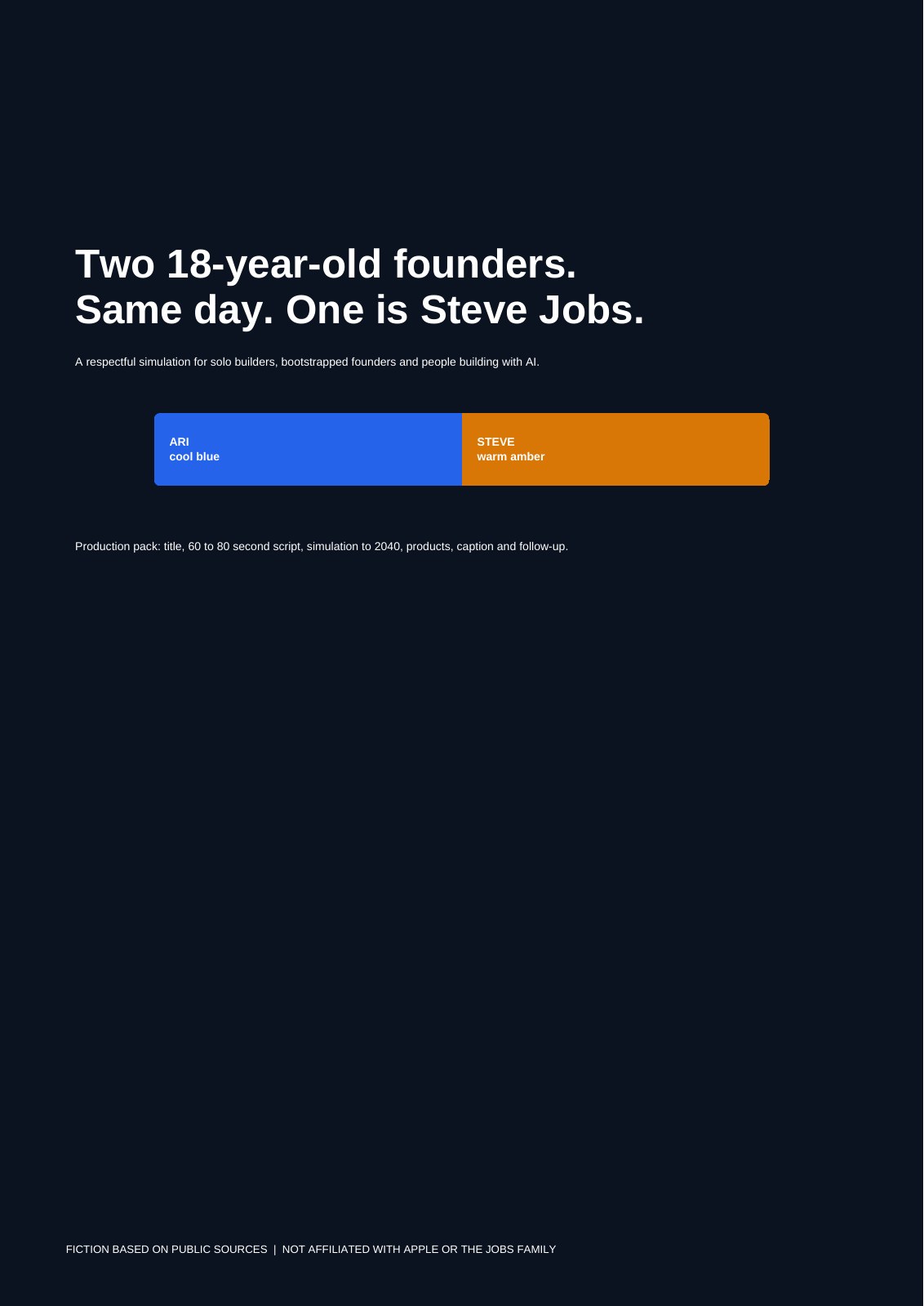
Loading…
Best: 🔵 AI agent startup vs 🟠 Steve Jobs: what wins in five years?
Alternative 1: 🔵 Build an agent vs 🟠 Build like Jobs: who changes everyday life?
Alternative 2: 🔵 Follow the funding vs 🟠 Follow the person: where are they in 2031?
Keep the selected question pinned throughout, including the closing frame. Blue always means Founder A; amber always means Steve. Both are faceless 3D figures, never caricatures. Keep both worlds visible inside cutaways.
75 seconds. Small persistent label: “Counterfactual simulation.” Numbers are modeled outcomes, not predictions. Music warms without making A’s side ominous.
| Time | What we see | Narration |
|---|---|---|
| 0–3s | Identical San Francisco desks. Both figures labeled 18. Calendar stamps NOV 12, 2026. Title locks overhead. | Two eighteen-year-olds start together. San Francisco, November twelfth, twenty twenty-six. |
| 3–9s | Blue assembles an insurance-authorization agent using Anthropic’s API. Amber sits opposite a nonspeaking customer, waiting rather than interrupting. Principle: Start with the experience. | A builds clinic agents. Steve Jobs starts with somebody unable to speak without assistance. |
| 9–15s | Blue clears a clinic’s authorization queue. Amber prototypes Sentence, a portable speech instrument: touch words or look at them; it speaks. $499. Core works offline. | A automates insurance approvals for understaffed neighborhood clinics. Steve designs dinner without somebody answering for you. |
| 15–21s | Inside both cap tables: blue’s $8m seed builds integrations; amber’s $1.5m seed funds fitting and hardware. An MIT research paper becomes a prototype. Principle: Fund the promise, not the fashion. | A raises eight million dollars. Steve licenses university research, then takes patient capital. |
| 21–27s | Blue adds adjacent clinic workflows. Amber crosses out diagnosis, translation, general assistant. One complete box contains device, stand, fitting appointment, repair instructions. Principle: Finish one job. | Steve rejects diagnosis, translation, and general assistants. One ordinary dinner conversation must work completely, even without internet. |
| 27–33s | Calendars accelerate together to NOV 12, 2031. Matching revenue rulers: blue $42m/year; amber $3m/year. Blue’s ruler rises higher. | Five years later. A makes forty-two million dollars; Steve’s company makes three. |
| 33–39s | A wins revenue receives a clean checkmark. An attempted therefore, everything stamp breaks apart. Both businesses remain standing. | A wins revenue. But revenue cannot tell us whose problem actually disappeared. |
| 39–45s | INSIDE 1: CUSTOMERS. Blue shows 48,000 authorization staff-hours saved/year. Amber shows 6,000 weekly independent communicators. Separate units stay visible. Principle: Measure the human outcome. | One: A saves clinics time. Steve helps six thousand people speak independently. |
| 45–51s | INSIDE 2: PRODUCT. Blue’s model supply lines glow, with Anthropic and Google alternatives. Amber’s circuit continues speaking after internet cables vanish. Fitting and repair teams remain connected. Principle: Own the essential experience. | Two: A rents intelligence. Steve owns the interface, fitting, repairs, and trust. |
| 51–57s | INSIDE 3: DECISIONS. Blue expands useful integrations. Amber moves its bestseller toward recycling, revealing a 2032 prototype: $299. Existing devices retain support. Principle: Replace yourself before rivals do. | Three: A expands workflows. Steve replaces the bestseller before somebody else can. |
| 57–63s | Inside amber’s team, an exceptional engineer leaves after repeated overnight revisions. Steve cancels the next overnight session. Blue’s team ships calmly. | Steve’s demands cost a brilliant engineer. Focus doesn’t excuse exhausting your team. |
| 63–69s | Blue’s clinic worker closes the office on time. Amber: imagined future breakfast with real AAC advocate Jordyn Zimmerman, rendered faceless. Her selected words sound; the waiter waits. Label: “Imagined use, not an endorsement.” | Jordyn orders breakfast without surrendering the conversation. The waiter waits for Jordyn, not the machine. |
| 69–75s | Three concise cards bridge both halves: ONE OUTCOME / WHOLE EXPERIENCE / SHIP IT. Final image: two thriving companies, two different kinds of leverage. Title remains. | Choose one human outcome, then finish the whole experience. Who should we do next? |
The supplied November 2026 brief defines the opening scenario, not verified future reporting. All subsequent companies, deals, prices and results below are fictional. A’s company is Clearline; Steve’s is Sentence. Neither has Apple connections.
“Raised” means new equity that year. No listed raise means $0. Both begin with identical laptops, coding tools and $5,000. Both recruit help; neither receives a ready-made team.
| Year | Founder A: built, raised, learned | Steve: built, raised, learned | World conditions |
|---|---|---|---|
| 2026 | Clearline authorization prototype; $8m seed. Learns clinic distribution beats demos. | Sentence mockups; $1.5m seed. Learns waiting is part of conversation. | Supplied scenario: agent rush; cheaper intelligence. |
| 2027 | Three paid clinic pilots; $12m. Learns humans must approve consequential submissions. | Recruits AAC specialist, embedded engineer, industrial designer; $3m. Tests MIT-derived gaze methods; touch remains available. | AI 2027’s fast coding scenario is a possibility, not a deadline. |
| 2028 | Integrates scheduling; $20m. Learns hospital procurement is slow. | Ships $499 Sentence One with customer-led launch; $0. Learns fitting matters as much as accuracy. | Scenario: coding improves; institutions adopt unevenly. |
| 2029 | Adds appeals drafting; $0. Learns audit trails retain customers. | Opens Oakland fitting studio; $0. Learns glare defeats a beautiful laboratory prototype. | Scenario: models commoditize faster than trusted distribution. |
| 2030 | Adds second model provider; $0. Learns switching costs persist beyond inference prices. | Ships glare-resistant revision; $0. Learns repair turnaround determines daily independence. | Forecast uncertainty remains; neither business requires AGI. |
| 2031 | $42m revenue; 92 staff; founder owns 18%. Validates 48,000 annual staff-hours saved. | $3m revenue; 18 staff; Steve owns 63%. Validates 6,000 weekly independent communicators. | Five-year checkpoint; incomparable outcomes are not added together. |
| 2032 | Adds multilingual administrative workflows; $0. Learns expansion can serve existing buyers. | Ships $299 Sentence Two; $0. Learns cheaper hardware expands access more than extra features. | Scenario: compact models make offline products more capable. |
| 2033 | Publishes correction-rate dashboard; $0. Learns reliability sells renewals. | Adds consent-based voice importing; $0. Learns identity requires explicit user control. | Scenario: synthetic-voice abuse increases demand for safeguards. |
| 2034 | Offers smaller-clinic tier; $0. Learns onboarding must shrink with price. | Scales partner fittings; $0. Learns retail staff cannot replace clinical expertise. | Scenario: service capacity becomes a bottleneck. |
| 2035 | Reaches operating profitability; $0. Learns growth need not require another round. | Reaches operating profitability; $0. Learns support reserves must precede international expansion. | No humanoid adoption assumption is needed. |
| 2036 | Adds insurer-policy monitoring; $0. Learns source provenance prevents costly errors. | Adds user-controlled language packs; $0. Learns translation must never silently alter intent. | Scenario: stronger models do not remove accountability. |
| 2037 | Expands outside California; $0. Learns rules remain local. | Adds regional repair partners; $0. Learns shipping distance is an accessibility issue. | Scenario: logistics constrain access more than inference. |
| 2038 | Wins public-clinic contracts; $0. Learns affordability changes purchasing criteria. | Adds public-library loan kits; $0. Learns trials reduce abandoned devices. | Scenario: public procurement broadens access unevenly. |
| 2039 | Ships portable audit exports; $0. Learns customer exit rights earn trust. | Publishes communication-file export format; $0. Learns personal language must outlive hardware. | Scenario: interoperability becomes a buying requirement. |
| 2040 | $190m revenue; 1,100 clinics. Learns durable infrastructure can be an agent company’s legacy. | $62m revenue; 180,000 active users. Learns scale means preserving service quality. | Scenario endpoint, not a forecast of inevitable adoption. |
A’s dilution buys speed and distribution. Steve’s smaller rounds require slower expansion and contracted manufacturing. Neither wins every column. Revenue is an incomplete score; venture funding is not a mistake.
Core speech never requires a subscription or internet. Optional $12/month support adds backup and priority loaners, not the right to communicate. No automatic statements, diagnoses or promised cures. Eye access requires individual assessment; touch remains available. MIT’s research is a starting point, not evidence of finished assistive-device performance.
Same starting day. Same tools. Different definitions of progress. One builds a valuable clinic agent. Steve builds around a conversation. Revenue chooses one winner. Open the companies and the answer changes.
✔ Tomorrow, observe one customer completing one task. Record what improves. ✔ List everything required for that outcome, including setup and failure recovery. ✔ Cut one distracting feature, ship the essential experience, fund its support.
Which would you protect first: faster growth, ownership, or the customer’s experience?
Sources:
Fiction based on public sources. Not affiliated with Apple or the Jobs family. AI voice and characters.
Why did the smaller company matter? Open both products and follow one request from first interaction to failure, repair and renewed trust.


