Loading page…
ANo public result yet Claude Opus 5.5
CNo public result yetClaude Fable 5.2
Claude Fable 5.2Output D, 1 turn
Loading answer…
Open full answerClaude Opus 5.5Claude Fable 5.2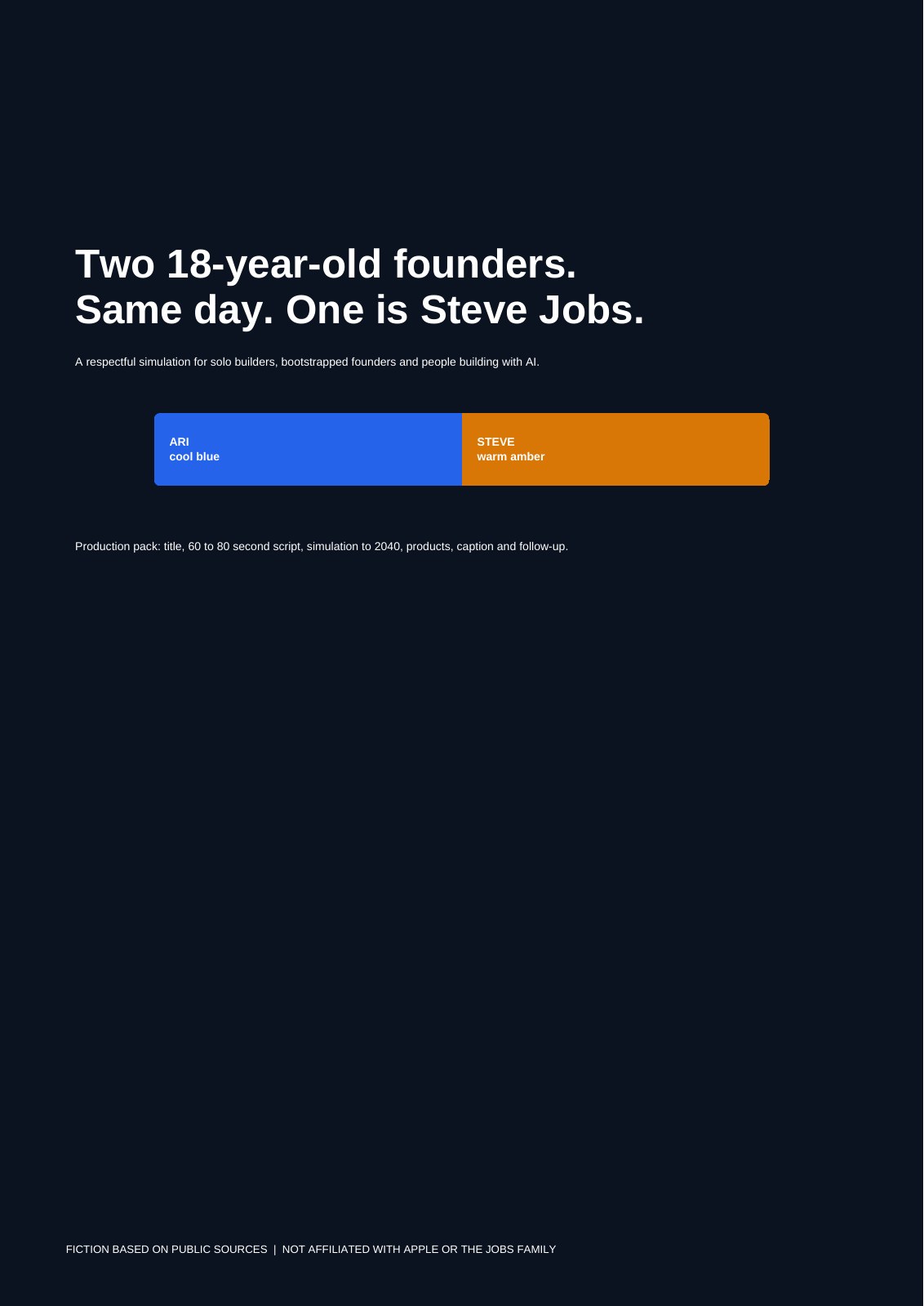
Best: 🔵 AI agent vs 🟠 Steve Jobs: who builds more in five years?
Alternatives:
Keep the selected question pinned through the final frame. Founder A stays cool blue; Steve stays warm amber. Both are faceless 3D figures, including during company cutaways.
73 seconds. Approximately 170 spoken words. Persistent small label: COUNTERFACTUAL SIMULATION. All business results are invented, not predictions.
| Time | What we see | Narration |
|---|---|---|
| 0–3 | Equal split. Two eighteen-year-olds enter identical Cambridge, Massachusetts workrooms. Date: November 12, 2026. Same laptop, APIs, $2,000 savings. | Two founders. Same tools. One is Steve Jobs. |
| 3–10 | Blue builds an accounts-receivable agent. Amber watches a blind pupil struggle with a graph. Labels: “Automate collections” / “Start with the person.” | Founder A builds agents that collect unpaid invoices. Steve starts with a child who cannot read the graph. |
| 10–17 | Blue: venture term sheet. Amber: paid publisher pilot and patient equity. Cap-table rings begin growing. Labels: “Speed” / “Match money to the mission.” | Founder A takes venture money to move faster. Steve sells a pilot before promising a platform. |
| 17–24 | Blue accepts three enterprise integrations. Amber deletes chat, camera, app store. A tactile page remains. Labels: “Expand accounts” / “Finish one experience.” | Founder A adds integrations customers will pay for. Steve refuses everything except a page you can feel. |
| 24–31 | Both calendars flip to November 12, 2031. Amber launches Folio: raised graph beside braille. Price: $1,499, no required subscription. | Five years later, the page ships for fifteen hundred dollars. Open your homework; feel the words and shapes. |
| 31–38 | Measurement: blue $120m valuation; amber $35m. Then blue: 20,000 verified staff hours saved/month. Amber: 8,000 active learners. No combined score. | Expected Steve to win the money race? Founder A wins that, and saves customers real working hours. |
| 38–45 | INSIDE 1: amber customer journey illuminates publisher → checked file → fingertips. Blue illuminates invoice → payment. Principle: “Own the whole experience.” | First: Steve builds the entire journey, not another model. The textbook reaches fingertips without a formatting queue. |
| 45–52 | INSIDE 2: blue investor ring 45%; amber 30%. Employee pools and founder stakes remain visible. Principle: “Buy time for quality.” | Second: patient money buys time for difficult hardware. Founder A gets speed; Steve keeps room to refuse. |
| 52–59 | INSIDE 3: tactile engineers, blind educators and accessibility reviewers surround one error trace. Rejected graphs glow red. Principle: “Verify the important thing.” | Third: blind educators can stop a release. A convincing wrong graph still fails. |
| 59–66 | Return to the real, unnamed pupil described by HumanWare. Clearly labeled “imagined continuation.” Blue office closes on time; amber pupil plots alongside classmates. | That pupil plots the graph while classmates are still plotting. Nobody has to wait for permission to participate. |
| 66–73 | Both figures remain equal size. Amber product dissolves into fingers following a curve; blue workers leave for home. Three principle cards settle beneath title. | Make one important moment work completely. Who should we do next? |
Premise: Both begin with equal access, without inherited fame or contacts. Founder A chooses the agent branch of the supplied November 2026 world. Steve has Jobs’s taste, not automatic manufacturing expertise.
Evidence boundary: November 2026 conditions come from the supplied scenario brief. Subsequent dates, deals, prices and outcomes below are fictional. The brief’s AI 2027 forecast range, roughly 2028–2032 for fully automated coding, informs cheaper software production, not guaranteed AGI. Mechanical reliability remains a separate problem.
Steve studies MIT’s inFORM research, then approaches DOT about tactile-cell supply and licensing. Neither agreement is asserted as real. HumanWare’s Monarch already does multiline braille and graphics: Steve does not invent tactile reading. The bet is a radically cheaper, narrower, publisher-to-page experience.
Table key: Financing is new money that year; “$0” means no new equity. Later years are scenario assumptions, not sourced forecasts.
| Year | Founder A: build / finance / learn | Steve: build / finance / learn | World state used |
|---|---|---|---|
| 2026 | Collections prototype; $0; interviews reveal reconciliation pain. | Twenty paid accessibility interviews; $0; reading order matters as much as pins. | Brief: agent proliferation and cheaper intelligence. |
| 2027 | Launches Ledger, $499/month; $2m seed; exceptions require humans. | Folio Press publisher pilot; $100k contract, not equity; tactile layouts require editorial judgment. | Coding automation remains a forecast, not a solved condition. |
| 2028 | Accounting integrations; $8m Series A; distribution beats demos. | $3m patient seed; recruits a tactile engineer and blind curriculum lead; prototypes fail cleaning tests. | Brief’s AI 2027 coding window begins. |
| 2029 | Approval controls; $0; autonomy must be bounded. | $5m equity; negotiates DOT supply and approaches APH for content rights; permission is not assumed. | Scenario: cheaper models, costly precision components. |
| 2030 | Channel sales; $0; profitable customers need onboarding. | Folio school pilots; $0; Steve’s perfectionism delays launch six months and loses an engineer. | Scenario: coding is easier than reliable hardware. |
| 2031 | $6m annual revenue, $120m financing valuation; $12m round; verifies 20,000 monthly hours saved. | Folio launches; 10,000 units shipped, 8,000 active learners; $2m round at $35m; learns service capacity limits growth. | Same five-year measurement date, different useful outcomes. |
| 2032 | Model switching layer; $0; negotiates with Anthropic and OpenAI instead of depending on one. | $0; dual-sources components; negotiates model pricing, keeps approved books readable offline. | Supplied coding forecast window ends without guaranteeing success. |
| 2033 | Supplier-payment workflow; $0; audit trails retain customers. | $0; repair depots and accessible tactile packaging; learns returns expose design mistakes. | Scenario: maintenance becomes a differentiator. |
| 2034 | Partner marketplace; $0; rejects consumer assistant distraction. | $0; privately tests cheaper Folio Mini; refuses a general-purpose tablet. | Scenario: incumbents also improve tactile displays. |
| 2035 | Industry-specific workflows; $0; customer trust protects margins. | Mini launches; $0; stops new original-Folio sales despite strong demand, preserves repairs. | Scenario: manufacturing yield enables lower prices. |
| 2036 | Worker training included; $0; adoption needs consent. | $0; multilingual publishing tools; learns translation is not tactile localization. | Scenario: accessibility procurement stays fragmented. |
| 2037 | Cooperative customer council; $0; buyers demand portability. | $0; opens interchange specification; accepts compatible competitors. | Scenario: open files lower switching costs. |
| 2038 | Exportable audit records; $0; earns renewals without lock-in. | $0; grants repair licenses; local service outperforms shipping every fault overseas. | Scenario: repairability affects purchasing. |
| 2039 | Stable specialist business; $0; abandons maximum-autonomy marketing. | $0; subsidized school purchasing from operating surplus; learns affordability includes training. | Scenario: access remains uneven. |
| 2040 | $45m annual revenue, profitable; $0; customers buy accountability. | 250,000 active readers, profitable; $0; success means competitors make accessible pages ordinary. | A possible outcome, not an inevitable technological destination. |
Five-year accounting: A has raised $22m; Steve $10m, plus the $100k pilot revenue. Illustrative fully diluted ownership: A 40%, employees 15%, investors 45%; Steve 55%, employees 15%, investors 30%. Valuations are financing marks, not cash or social worth. Hours saved are measured against customer baselines; learners are monthly active users. Neither measure proves superiority over the other.
Folio’s hardest assumption is its price: target landed manufacturing cost $750 at 10,000 units, before service, distribution and engineering. If yield misses that target, $1,499 fails.
These tools complement braille instruction. Automatic conversions remain drafts until checked. Monarch’s listed $15,500 price is a reference point, not a promise of feature equivalence.
Same birthday year. Same tools. Different definitions of progress. The agent founder builds a valuable business and gives workers time back. Steve builds a tactile page that lets more people join in.
✔ Tomorrow, watch one customer complete one difficult task before opening your editor. ✔ Write one acceptance test for the whole experience, including failure and repair. ✔ Choose financing that can survive your actual development cycle; delete three distractions.
Which moment in your customer’s day deserves this much care?
Sources:
Fiction based on public sources. Not affiliated with Apple or the Jobs family. AI voice and characters.
Why did the cheaper tactile page take longer to build? Open both companies to compare a one-minute software fix with one failed pin, one unreadable graph and one repair journey.
 GPT-6 Astra


