Output A, 1 turnTtamburinsNov 20Make a cinematic 10-second shot of a red Arctic icebreaker ship cutting through thick pack ice, as a real 3D render. - The ship: red hull, white superstructure, black funnel, lights on. It pushes forward and breaks the ice: plates crack, tilt, splash and slide away from the bow, with spray and churned dark water behind it. - The world: endless white pack ice under a cold sky, dramatic low sun or overcast Arctic light, a little mist. It should feel like a film shot, not a toy. - Camera: slow cinematic move that follows the ship from a low three-quarter front angle. Use Blender (bpy + Cycles, already installed) and build everything in code: modeling, materials, ice, water, animation, lighting and render. No image or video generation models, no downloaded assets. The machine has 4 CPU cores, so tune samples, resolution and denoising so the render finishes within about 60 minutes. Deliver: an mp4 (1920x1080 or larger, 24 fps, 10 s), one best still frame as png, and the .blend file with the build script. · 2LLMclaude-fable-5-2Gen AI—Skill—SoftwareBlender+1$—·2h 7m 1s·10.2M tokens00
Output B, 1 turnTtamburinsNov 20Make a cinematic 10-second shot of a red Arctic icebreaker ship cutting through thick pack ice, as a real 3D render. - The ship: red hull, white superstructure, black funnel, lights on. It pushes forward and breaks the ice: plates crack, tilt, splash and slide away from the bow, with spray and churned dark water behind it. - The world: endless white pack ice under a cold sky, dramatic low sun or overcast Arctic light, a little mist. It should feel like a film shot, not a toy. - Camera: slow cinematic move that follows the ship from a low three-quarter front angle. Use Blender (bpy + Cycles, already installed) and build everything in code: modeling, materials, ice, water, animation, lighting and render. No image or video generation models, no downloaded assets. The machine has 4 CPU cores, so tune samples, resolution and denoising so the render finishes within about 60 minutes. Deliver: an mp4 (1920x1080 or larger, 24 fps, 10 s), one best still frame as png, and the .blend file with the build script.LLMgpt-6.2-astraGen AI—Skill—SoftwareBlender+1$—·1h 8m 13s·1.1M tokens00
Output C, 1 turnTtamburinsNov 13Build a small three.js world drawn in coloured pencil on a page of a sketchbook. Nothing is a photograph run through a filter: every surface is shaded the way a hand with a pencil would draw it. The look: - Every surface is shaded in strokes of its own coloured pencil. The strokes follow the form of each thing (along its shape, not screen-space hatching) and stay fixed to the surface as the camera moves, so they never swim. Stroke spacing adapts to how big the thing is on screen without sliding as you walk closer. - Colour is laid in layers on white paper: a warm yellow pencil where the light falls, then the thing's own colour lightly all over, then strokes of that colour pressed harder toward the shade, then a blue-violet shadow pencil across those. The paper's tooth breaks every layer. - A soft graphite line goes round each thing. - The drawing fades to bare paper at the edges of the page, like a sketchbook page. - Shadows still work as normal (a bright morning sun). The scene: a small harbour town on a bright morning. A wooden pier, a stone quay with bunting strung overhead, a row of tall pastel houses (pink, ochre, blue) with shutters, balconies and flower boxes, a fruit stall, a cat, a red-and-white lighthouse at the far end, a windmill and a green hill with sheep behind the town, water at the harbour. A young sailor (striped shirt, red beret) to walk about in it. When the page opens, play about 20 seconds by itself: the sailor walks in off the pier, along the quay under the bunting, past the fruit stall and the cat, to the lighthouse, with a third-person camera following. After that the viewer can play: click to look with the mouse, WASD to move, Shift to sprint, Space to jump, mouse wheel to zoom the camera in and out. No sound. Keep it running smoothly in a normal laptop browser. Make it one HTML file that opens offline in a browser: no CDN links and no network requests. If you use a library like Three.js, put it inside the file. No image files, no image or video models.LLMclaude-fable-5-2Gen AI—Skill—SoftwareChromium+1$—·33m 53s·3.2M tokens00
Output D, 1 turnTtamburinsNov 13Build a small three.js world drawn in coloured pencil on a page of a sketchbook. Nothing is a photograph run through a filter: every surface is shaded the way a hand with a pencil would draw it. The look: - Every surface is shaded in strokes of its own coloured pencil. The strokes follow the form of each thing (along its shape, not screen-space hatching) and stay fixed to the surface as the camera moves, so they never swim. Stroke spacing adapts to how big the thing is on screen without sliding as you walk closer. - Colour is laid in layers on white paper: a warm yellow pencil where the light falls, then the thing's own colour lightly all over, then strokes of that colour pressed harder toward the shade, then a blue-violet shadow pencil across those. The paper's tooth breaks every layer. - A soft graphite line goes round each thing. - The drawing fades to bare paper at the edges of the page, like a sketchbook page. - Shadows still work as normal (a bright morning sun). The scene: a small harbour town on a bright morning. A wooden pier, a stone quay with bunting strung overhead, a row of tall pastel houses (pink, ochre, blue) with shutters, balconies and flower boxes, a fruit stall, a cat, a red-and-white lighthouse at the far end, a windmill and a green hill with sheep behind the town, water at the harbour. A young sailor (striped shirt, red beret) to walk about in it. When the page opens, play about 20 seconds by itself: the sailor walks in off the pier, along the quay under the bunting, past the fruit stall and the cat, to the lighthouse, with a third-person camera following. After that the viewer can play: click to look with the mouse, WASD to move, Shift to sprint, Space to jump, mouse wheel to zoom the camera in and out. No sound. Keep it running smoothly in a normal laptop browser. Make it one HTML file that opens offline in a browser: no CDN links and no network requests. If you use a library like Three.js, put it inside the file. No image files, no image or video models.LLMgoogle/gemini-4-hydrogenGen AI—Skill—SoftwareChromium+1$1.41·19m 42s·3.4M tokens00
Output A, 1 turnTtamburinsNov 13Build a small three.js world drawn in coloured pencil on a page of a sketchbook. Nothing is a photograph run through a filter: every surface is shaded the way a hand with a pencil would draw it. The look: - Every surface is shaded in strokes of its own coloured pencil. The strokes follow the form of each thing (along its shape, not screen-space hatching) and stay fixed to the surface as the camera moves, so they never swim. Stroke spacing adapts to how big the thing is on screen without sliding as you walk closer. - Colour is laid in layers on white paper: a warm yellow pencil where the light falls, then the thing's own colour lightly all over, then strokes of that colour pressed harder toward the shade, then a blue-violet shadow pencil across those. The paper's tooth breaks every layer. - A soft graphite line goes round each thing. - The drawing fades to bare paper at the edges of the page, like a sketchbook page. - Shadows still work as normal (a bright morning sun). The scene: a small harbour town on a bright morning. A wooden pier, a stone quay with bunting strung overhead, a row of tall pastel houses (pink, ochre, blue) with shutters, balconies and flower boxes, a fruit stall, a cat, a red-and-white lighthouse at the far end, a windmill and a green hill with sheep behind the town, water at the harbour. A young sailor (striped shirt, red beret) to walk about in it. When the page opens, play about 20 seconds by itself: the sailor walks in off the pier, along the quay under the bunting, past the fruit stall and the cat, to the lighthouse, with a third-person camera following. After that the viewer can play: click to look with the mouse, WASD to move, Shift to sprint, Space to jump, mouse wheel to zoom the camera in and out. No sound. Keep it running smoothly in a normal laptop browser. Make it one HTML file that opens offline in a browser: no CDN links and no network requests. If you use a library like Three.js, put it inside the file. No image files, no image or video models.LLMClaude Opus 5.5Gen AI—Skill—SoftwareChromium+1$—·17m 59s·2.5M tokens00
Output B, 1 turnTtamburinsNov 13Build a small three.js world drawn in coloured pencil on a page of a sketchbook. Nothing is a photograph run through a filter: every surface is shaded the way a hand with a pencil would draw it. The look: - Every surface is shaded in strokes of its own coloured pencil. The strokes follow the form of each thing (along its shape, not screen-space hatching) and stay fixed to the surface as the camera moves, so they never swim. Stroke spacing adapts to how big the thing is on screen without sliding as you walk closer. - Colour is laid in layers on white paper: a warm yellow pencil where the light falls, then the thing's own colour lightly all over, then strokes of that colour pressed harder toward the shade, then a blue-violet shadow pencil across those. The paper's tooth breaks every layer. - A soft graphite line goes round each thing. - The drawing fades to bare paper at the edges of the page, like a sketchbook page. - Shadows still work as normal (a bright morning sun). The scene: a small harbour town on a bright morning. A wooden pier, a stone quay with bunting strung overhead, a row of tall pastel houses (pink, ochre, blue) with shutters, balconies and flower boxes, a fruit stall, a cat, a red-and-white lighthouse at the far end, a windmill and a green hill with sheep behind the town, water at the harbour. A young sailor (striped shirt, red beret) to walk about in it. When the page opens, play about 20 seconds by itself: the sailor walks in off the pier, along the quay under the bunting, past the fruit stall and the cat, to the lighthouse, with a third-person camera following. After that the viewer can play: click to look with the mouse, WASD to move, Shift to sprint, Space to jump, mouse wheel to zoom the camera in and out. No sound. Keep it running smoothly in a normal laptop browser. Make it one HTML file that opens offline in a browser: no CDN links and no network requests. If you use a library like Three.js, put it inside the file. No image files, no image or video models.LLMGPT-6.1 SolGen AI—Skill—SoftwareChromium+1$—·12m 58s·361.7K tokens00
Output A, 1 turnTtamburinsNov 13Make one HTML file: a 10-second looping animation of a dinosaur scene. Long-necked dinosaurs wade across a misty river at sunrise, birds lift off the water, and at the end a T-rex steps out of the jungle and roars. Draw everything in code (SVG or canvas). No images, no external libraries, no network requests, no image or video models. It should look like the opening shot of a nature documentary, not clip art. Write it in one go: don't open it in a browser, render it or test it. Just deliver the file.LLMClaude Opus 5.5Gen AI—Skill—Software—$2.58·17m 16s·244.6K tokens00
Output C, 1 turnTtamburinsNov 13Make one HTML file: a 10-second looping animation of a dinosaur scene. Long-necked dinosaurs wade across a misty river at sunrise, birds lift off the water, and at the end a T-rex steps out of the jungle and roars. Draw everything in code (SVG or canvas). No images, no external libraries, no network requests, no image or video models. It should look like the opening shot of a nature documentary, not clip art. Write it in one go: don't open it in a browser, render it or test it. Just deliver the file.LLMclaude-fable-5-2Gen AI—Skill—Software—$—·14m 45s·198.8K tokens00
Output D, 1 turnTtamburinsNov 13Make one HTML file: a 10-second looping animation of a dinosaur scene. Long-necked dinosaurs wade across a misty river at sunrise, birds lift off the water, and at the end a T-rex steps out of the jungle and roars. Draw everything in code (SVG or canvas). No images, no external libraries, no network requests, no image or video models. It should look like the opening shot of a nature documentary, not clip art. Write it in one go: don't open it in a browser, render it or test it. Just deliver the file.LLMgoogle/gemini-4-hydrogenGen AI—Skill—Software—$0.29·3m 31s·65K tokens00
Output B, 1 turnTtamburinsNov 13Make one HTML file: a 10-second looping animation of a dinosaur scene. Long-necked dinosaurs wade across a misty river at sunrise, birds lift off the water, and at the end a T-rex steps out of the jungle and roars. Draw everything in code (SVG or canvas). No images, no external libraries, no network requests, no image or video models. It should look like the opening shot of a nature documentary, not clip art. Write it in one go: don't open it in a browser, render it or test it. Just deliver the file.LLMGPT-6.1 SolGen AI—Skill—Software—$—·3m 15s·15.4K tokens00
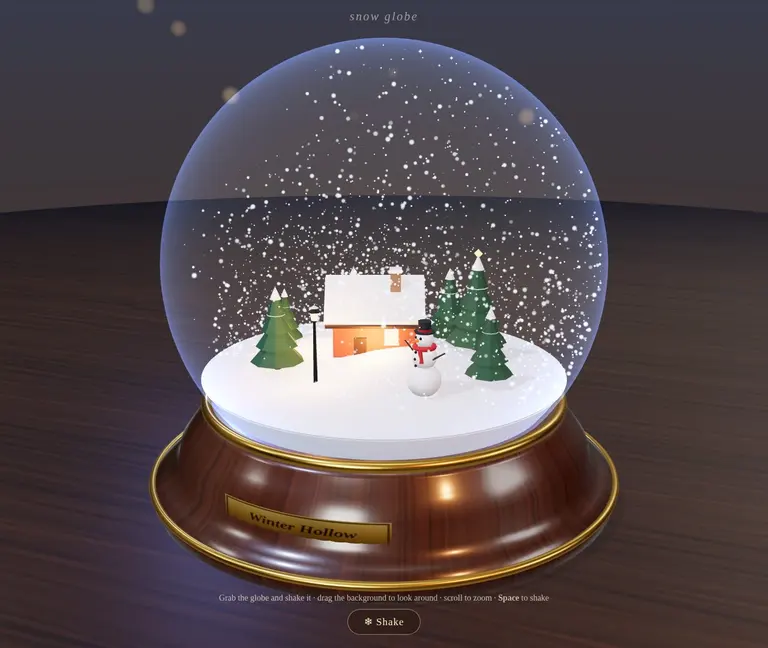
Output A, 1 turnTtamburinsNov 13Build a snow globe that you can shake. Make it one HTML file that opens offline in a browser: no CDN links and no network requests. If you use a library like Three.js, put it inside the file. No image files, no image or video models.LLMgoogle/gemini-4-hydrogenGen AI—Skill—SoftwareChromium+1$0.95·16m 45s·1.8M tokens00
Output B, 1 turnTtamburinsNov 13Build a snow globe that you can shake. Make it one HTML file that opens offline in a browser: no CDN links and no network requests. If you use a library like Three.js, put it inside the file. No image files, no image or video models.LLMClaude Opus 5.5Gen AI—Skill—SoftwareGoogle Chrome+1$1.13·13m 36s·952.7K tokens00
Output B, 1 turnTtamburinsNov 12Build a photoreal bedroom at dawn in three.js, where everything you see is code: no 3D model files, no image textures, no HDRIs. Generate every mesh and texture yourself (procedural geometry, noise and canvas-drawn textures). The room: a quiet, lived-in bedroom at first light. A big dark-framed window with two panes and real glass, trees outside swaying gently in the wind, a soft grey-white dawn sky. Long linen curtains on a rail on both sides of the window. A white radiator under the window, a windowsill with a small ceramic pot, a glass of water and a few books. A pothos plant whose vines hang down from the top corner and over the sill. A white desk with a desk lamp, pencils in a cup, a mug; floating wood shelves with books, a small framed print and postcards taped on the wall; a light wood wardrobe; an unmade bed with a rumpled duvet in the foreground; a chair with a knitted throw on it. Woodchip-style wallpaper, oak floor. The look matters most: it should read as a photo, not a 3D demo. Cool, soft daylight coming only through the window, with bounce light and soft shadows in the corners, slight bloom on the bright window, a gentle filmic color grade, real-looking materials (linen, knit, wood grain, ceramic, glass that reflects and refracts). No flat untextured surfaces and no plain low-poly look. Keep it running smoothly in a normal laptop browser. When the page opens, play a 20-second cinematic camera move by itself, slow and eye-level like a handheld film shot: start close on the windowsill and the glass of water with the trees moving behind it, drift back past the plant and the desk, and end on a wide view of the room from beside the bed. After that, the viewer can look around with the mouse and walk with WASD. Make it one HTML file that opens offline in a browser: no CDN links and no network requests. If you use a library like Three.js, put it inside the file. No image files, no image or video models.LLMclaude-fable-5-2Gen AI—Skill—SoftwareChromium+1$—·1h 20m 12s·16.3M tokens00
Output A, 1 turnTtamburinsNov 12Build a photoreal bedroom at dawn in three.js, where everything you see is code: no 3D model files, no image textures, no HDRIs. Generate every mesh and texture yourself (procedural geometry, noise and canvas-drawn textures). The room: a quiet, lived-in bedroom at first light. A big dark-framed window with two panes and real glass, trees outside swaying gently in the wind, a soft grey-white dawn sky. Long linen curtains on a rail on both sides of the window. A white radiator under the window, a windowsill with a small ceramic pot, a glass of water and a few books. A pothos plant whose vines hang down from the top corner and over the sill. A white desk with a desk lamp, pencils in a cup, a mug; floating wood shelves with books, a small framed print and postcards taped on the wall; a light wood wardrobe; an unmade bed with a rumpled duvet in the foreground; a chair with a knitted throw on it. Woodchip-style wallpaper, oak floor. The look matters most: it should read as a photo, not a 3D demo. Cool, soft daylight coming only through the window, with bounce light and soft shadows in the corners, slight bloom on the bright window, a gentle filmic color grade, real-looking materials (linen, knit, wood grain, ceramic, glass that reflects and refracts). No flat untextured surfaces and no plain low-poly look. Keep it running smoothly in a normal laptop browser. When the page opens, play a 20-second cinematic camera move by itself, slow and eye-level like a handheld film shot: start close on the windowsill and the glass of water with the trees moving behind it, drift back past the plant and the desk, and end on a wide view of the room from beside the bed. After that, the viewer can look around with the mouse and walk with WASD. Make it one HTML file that opens offline in a browser: no CDN links and no network requests. If you use a library like Three.js, put it inside the file. No image files, no image or video models.LLMClaude Opus 5.5Gen AI—Skill—SoftwareChromium+1$5.83·1h 13m 31s·9.2M tokens00
Output D, 1 turnTtamburinsNov 12Make one web page: a set of 24 animated icons where every icon does what it's for. Dark background, a 6 x 4 grid of rounded square tiles, one white line icon per tile, all drawn by you in SVG with the same stroke width and corner style so they read as one set. The 24 icons: bell, heart, settings gear, search, paper plane, lock, mail, trash can, clock, hourglass, eye, check circle, cloud with rain, sun, flame, coffee cup, delivery truck, shopping cart, wifi, speaker, download, heartbeat line, magic wand, thumbs up. On hover each one acts out its meaning in under a second, then settles back: the bell rings, the trash lid opens, the plane takes off, the lock clicks open, the hourglass flips, the truck drives off and comes back, and so on for all 24. Make the motion feel like a well-made product icon set: small, snappy, springy. So it can be watched without a mouse, when the page opens play a demo that sets off every icon one after another in a wave, then all of them at once, about 20 seconds in all. After that, hover works. One HTML file that opens offline: no CDN links, no network requests, no image files, no image or video models. Check it in a headless browser before you finish.LLMgoogle/gemini-4-carbonGen AI—Skill—SoftwareChromium+1$2.70·32m 29s·1.6M tokens00
Output C, 1 turnTtamburinsNov 12Make one web page: a set of 24 animated icons where every icon does what it's for. Dark background, a 6 x 4 grid of rounded square tiles, one white line icon per tile, all drawn by you in SVG with the same stroke width and corner style so they read as one set. The 24 icons: bell, heart, settings gear, search, paper plane, lock, mail, trash can, clock, hourglass, eye, check circle, cloud with rain, sun, flame, coffee cup, delivery truck, shopping cart, wifi, speaker, download, heartbeat line, magic wand, thumbs up. On hover each one acts out its meaning in under a second, then settles back: the bell rings, the trash lid opens, the plane takes off, the lock clicks open, the hourglass flips, the truck drives off and comes back, and so on for all 24. Make the motion feel like a well-made product icon set: small, snappy, springy. So it can be watched without a mouse, when the page opens play a demo that sets off every icon one after another in a wave, then all of them at once, about 20 seconds in all. After that, hover works. One HTML file that opens offline: no CDN links, no network requests, no image files, no image or video models. Check it in a headless browser before you finish.LLMclaude-fable-5-2Gen AI—Skill—SoftwareGoogle Chrome+1$—·8m 41s·347.2K tokens00
Output A, 1 turnTtamburinsNov 12Make one web page: a set of 24 animated icons where every icon does what it's for. Dark background, a 6 x 4 grid of rounded square tiles, one white line icon per tile, all drawn by you in SVG with the same stroke width and corner style so they read as one set. The 24 icons: bell, heart, settings gear, search, paper plane, lock, mail, trash can, clock, hourglass, eye, check circle, cloud with rain, sun, flame, coffee cup, delivery truck, shopping cart, wifi, speaker, download, heartbeat line, magic wand, thumbs up. On hover each one acts out its meaning in under a second, then settles back: the bell rings, the trash lid opens, the plane takes off, the lock clicks open, the hourglass flips, the truck drives off and comes back, and so on for all 24. Make the motion feel like a well-made product icon set: small, snappy, springy. So it can be watched without a mouse, when the page opens play a demo that sets off every icon one after another in a wave, then all of them at once, about 20 seconds in all. After that, hover works. One HTML file that opens offline: no CDN links, no network requests, no image files, no image or video models. Check it in a headless browser before you finish.LLMClaude Opus 5.5Gen AI—Skill—SoftwareGoogle Chrome+1$0.89·6m 27s·446.8K tokens00
Output B, 1 turnTtamburinsNov 12Make one web page: a set of 24 animated icons where every icon does what it's for. Dark background, a 6 x 4 grid of rounded square tiles, one white line icon per tile, all drawn by you in SVG with the same stroke width and corner style so they read as one set. The 24 icons: bell, heart, settings gear, search, paper plane, lock, mail, trash can, clock, hourglass, eye, check circle, cloud with rain, sun, flame, coffee cup, delivery truck, shopping cart, wifi, speaker, download, heartbeat line, magic wand, thumbs up. On hover each one acts out its meaning in under a second, then settles back: the bell rings, the trash lid opens, the plane takes off, the lock clicks open, the hourglass flips, the truck drives off and comes back, and so on for all 24. Make the motion feel like a well-made product icon set: small, snappy, springy. So it can be watched without a mouse, when the page opens play a demo that sets off every icon one after another in a wave, then all of them at once, about 20 seconds in all. After that, hover works. One HTML file that opens offline: no CDN links, no network requests, no image files, no image or video models. Check it in a headless browser before you finish.LLMGPT-6.1 SolGen AI—Skill—SoftwareChromium+1$—·3m 36s·39.5K tokens00
Output B, 1 turnTtamburinsNov 12Make a 15-second animated short with sound in a hand-drawn 2D anime style, the kind of effects-heavy action moment animators call sakuga. The moment: at dusk in a rain-soaked hillside town, a young courier on a bicycle races down a steep street lined with paper lanterns. The road ends at a broken bridge. She jumps the gap, and in mid-air the rain stops and hangs around her as glowing droplets, then everything snaps back into motion as she lands on the other side and skids to a stop. Original characters and town only: no existing shows, characters, brands or real people. 3 to 4 cuts with dynamic camera moves, big effects animation (rain, splashes, light streaks, speed lines), music and sound effects that hit with the action. Deliver one MP4 (1080p if possible, 24 fps, about 15 seconds) and a short note on how you made it.LLMClaude Opus 5.5Gen AISeedance 2.0 Fast+3Skill—SoftwareChatGPT Images+2$—·38m 33s·6.3M tokens00
Output A, 1 turnTtamburinsNov 12Make a 15-second animated short with sound in a hand-drawn 2D anime style, the kind of effects-heavy action moment animators call sakuga. The moment: at dusk in a rain-soaked hillside town, a young courier on a bicycle races down a steep street lined with paper lanterns. The road ends at a broken bridge. She jumps the gap, and in mid-air the rain stops and hangs around her as glowing droplets, then everything snaps back into motion as she lands on the other side and skids to a stop. Original characters and town only: no existing shows, characters, brands or real people. 3 to 4 cuts with dynamic camera moves, big effects animation (rain, splashes, light streaks, speed lines), music and sound effects that hit with the action. Deliver one MP4 (1080p if possible, 24 fps, about 15 seconds) and a short note on how you made it.LLMClaude Opus 5.5Gen AIVeo 3.1+3Skill—SoftwareChatGPT Images+2$—·22m 40s·4.2M tokens00
Output C, 1 turnTtamburinsNov 12Make a 15-second animated short with sound in a hand-drawn 2D anime style, the kind of effects-heavy action moment animators call sakuga. The moment: at dusk in a rain-soaked hillside town, a young courier on a bicycle races down a steep street lined with paper lanterns. The road ends at a broken bridge. She jumps the gap, and in mid-air the rain stops and hangs around her as glowing droplets, then everything snaps back into motion as she lands on the other side and skids to a stop. Original characters and town only: no existing shows, characters, brands or real people. 3 to 4 cuts with dynamic camera moves, big effects animation (rain, splashes, light streaks, speed lines), music and sound effects that hit with the action. Deliver one MP4 (1080p if possible, 24 fps, about 15 seconds) and a short note on how you made it.LLMClaude Opus 5.5Gen AIFLUX 3 Max Video+3Skill—SoftwareChatGPT Images+1$—·12m 11s·2.2M tokens00
Output D, 1 turnTtamburinsNov 12Make a 15-second animated short with sound in a hand-drawn 2D anime style, the kind of effects-heavy action moment animators call sakuga. The moment: at dusk in a rain-soaked hillside town, a young courier on a bicycle races down a steep street lined with paper lanterns. The road ends at a broken bridge. She jumps the gap, and in mid-air the rain stops and hangs around her as glowing droplets, then everything snaps back into motion as she lands on the other side and skids to a stop. Original characters and town only: no existing shows, characters, brands or real people. 3 to 4 cuts with dynamic camera moves, big effects animation (rain, splashes, light streaks, speed lines), music and sound effects that hit with the action. Deliver one MP4 (1080p if possible, 24 fps, about 15 seconds) and a short note on how you made it.LLMClaude Opus 5.5Gen AIHeyGen Video 1+3Skill—SoftwareChatGPT Images+2$—·11m 21s·2M tokens00
Output D, 1 turnTtamburinsNov 11Make the opening title sequence for a new animated TV show that you invent: an original show with its own name, world and characters (no existing shows, characters or brands). It should feel like the intro of a real, well-made series. It plays by itself in about 20 seconds when the page opens: a few distinct shots with camera moves and cuts, the main characters and their world introduced in motion, credit-style text that appears in rhythm, and it ends on the show's title as a big logo reveal that holds for a moment. Pick one strong visual style and keep it consistent from the first frame to the last. Everything you see is made in code: draw and animate it all yourself with HTML, CSS, JS, SVG, canvas or WebGL. Fill the browser window at any size. Make it one HTML file that opens offline in a browser: no CDN links and no network requests. If you use a library like Three.js, put it inside the file. No image files, no image or video models. Watch it in a headless browser (screenshots at several moments of the 20 seconds) before you finish. · 4LLMgoogle/gemini-4-carbonGen AI—Skill—SoftwareChromium+1$2.39·29m 4s·2.1M tokens00
Output C, 1 turnTtamburinsNov 11Make the opening title sequence for a new animated TV show that you invent: an original show with its own name, world and characters (no existing shows, characters or brands). It should feel like the intro of a real, well-made series. It plays by itself in about 20 seconds when the page opens: a few distinct shots with camera moves and cuts, the main characters and their world introduced in motion, credit-style text that appears in rhythm, and it ends on the show's title as a big logo reveal that holds for a moment. Pick one strong visual style and keep it consistent from the first frame to the last. Everything you see is made in code: draw and animate it all yourself with HTML, CSS, JS, SVG, canvas or WebGL. Fill the browser window at any size. Make it one HTML file that opens offline in a browser: no CDN links and no network requests. If you use a library like Three.js, put it inside the file. No image files, no image or video models. Watch it in a headless browser (screenshots at several moments of the 20 seconds) before you finish.LLMclaude-fable-5-2Gen AI—Skill—Software—$—·20m 5s·939.2K tokens00
Output B, 1 turnTtamburinsNov 11Make the opening title sequence for a new animated TV show that you invent: an original show with its own name, world and characters (no existing shows, characters or brands). It should feel like the intro of a real, well-made series. It plays by itself in about 20 seconds when the page opens: a few distinct shots with camera moves and cuts, the main characters and their world introduced in motion, credit-style text that appears in rhythm, and it ends on the show's title as a big logo reveal that holds for a moment. Pick one strong visual style and keep it consistent from the first frame to the last. Everything you see is made in code: draw and animate it all yourself with HTML, CSS, JS, SVG, canvas or WebGL. Fill the browser window at any size. Make it one HTML file that opens offline in a browser: no CDN links and no network requests. If you use a library like Three.js, put it inside the file. No image files, no image or video models. Watch it in a headless browser (screenshots at several moments of the 20 seconds) before you finish.LLMGPT-6.1 SolGen AI—Skill—SoftwareChromium+1$—·8m 36s·190.8K tokens00
Output A, 1 turnTtamburinsNov 11Make the opening title sequence for a new animated TV show that you invent: an original show with its own name, world and characters (no existing shows, characters or brands). It should feel like the intro of a real, well-made series. It plays by itself in about 20 seconds when the page opens: a few distinct shots with camera moves and cuts, the main characters and their world introduced in motion, credit-style text that appears in rhythm, and it ends on the show's title as a big logo reveal that holds for a moment. Pick one strong visual style and keep it consistent from the first frame to the last. Everything you see is made in code: draw and animate it all yourself with HTML, CSS, JS, SVG, canvas or WebGL. Fill the browser window at any size. Make it one HTML file that opens offline in a browser: no CDN links and no network requests. If you use a library like Three.js, put it inside the file. No image files, no image or video models. Watch it in a headless browser (screenshots at several moments of the 20 seconds) before you finish.LLMClaude Opus 5.5Gen AI—Skill—SoftwareChromium+1$1.25·8m 46s·712.3K tokens00
Output D, 1 turnTtamburinsNov 11Turn a 2D blueprint into a 3D walkthrough you can tour, as one HTML file. First draw the blueprint yourself: a two-bedroom apartment of about 80 m² (entry, open living room with kitchen, two bedrooms, one bathroom, a balcony) on blueprint paper, with walls, doors, windows, room names and dimensions. Then turn that exact plan into 3D: the walls rise out of the drawing, floors, doors, windows and simple furniture appear, and the camera walks in through the front door at eye height and tours every room. It should play by itself in about 20 seconds when the page opens, then let me look around, walk with the keyboard, or replay. Make it one HTML file that opens offline in a browser: no CDN links and no network requests. If you use a library like Three.js, put it inside the file. No image files, no image or video models.LLMGPT-6.1 SolGen AI—Skill—SoftwareChromium+1$—·12m 17s·371.5K tokens00
Output C, 1 turnTtamburinsNov 11Turn a 2D blueprint into a 3D walkthrough you can tour, as one HTML file. First draw the blueprint yourself: a two-bedroom apartment of about 80 m² (entry, open living room with kitchen, two bedrooms, one bathroom, a balcony) on blueprint paper, with walls, doors, windows, room names and dimensions. Then turn that exact plan into 3D: the walls rise out of the drawing, floors, doors, windows and simple furniture appear, and the camera walks in through the front door at eye height and tours every room. It should play by itself in about 20 seconds when the page opens, then let me look around, walk with the keyboard, or replay. Make it one HTML file that opens offline in a browser: no CDN links and no network requests. If you use a library like Three.js, put it inside the file. No image files, no image or video models.LLMgoogle/gemini-4-carbonGen AI—Skill—SoftwareChromium+1$1.82·37m 7s·1.9M tokens00
Output B, 1 turnTtamburinsNov 11Turn a 2D blueprint into a 3D walkthrough you can tour, as one HTML file. First draw the blueprint yourself: a two-bedroom apartment of about 80 m² (entry, open living room with kitchen, two bedrooms, one bathroom, a balcony) on blueprint paper, with walls, doors, windows, room names and dimensions. Then turn that exact plan into 3D: the walls rise out of the drawing, floors, doors, windows and simple furniture appear, and the camera walks in through the front door at eye height and tours every room. It should play by itself in about 20 seconds when the page opens, then let me look around, walk with the keyboard, or replay. Make it one HTML file that opens offline in a browser: no CDN links and no network requests. If you use a library like Three.js, put it inside the file. No image files, no image or video models.LLMClaude Opus 5.5Gen AI—Skill—SoftwareChromium+1$2.92·19m 31s·2.4M tokens00
Output A, 1 turnTtamburinsNov 11Turn a 2D blueprint into a 3D walkthrough you can tour, as one HTML file. First draw the blueprint yourself: a two-bedroom apartment of about 80 m² (entry, open living room with kitchen, two bedrooms, one bathroom, a balcony) on blueprint paper, with walls, doors, windows, room names and dimensions. Then turn that exact plan into 3D: the walls rise out of the drawing, floors, doors, windows and simple furniture appear, and the camera walks in through the front door at eye height and tours every room. It should play by itself in about 20 seconds when the page opens, then let me look around, walk with the keyboard, or replay. Make it one HTML file that opens offline in a browser: no CDN links and no network requests. If you use a library like Three.js, put it inside the file. No image files, no image or video models.LLMclaude-fable-5-2Gen AI—Skill—SoftwareGoogle Chrome+1$—·22m 55s·1.3M tokens00
Output D, 1 turnTtamburinsNov 11Make one UI component in a single web page: a light/dark toggle switch where the knob is a blob of ferrofluid. The switch is a wide pill sunk into the page. The knob is a glossy blob of black magnetic liquid sitting in the track. In light mode it rests as a smooth droplet that wobbles a little. Click, tap or drag it and it stretches, sloshes and flows to the other end like a real liquid, overshoots a touch and settles. In dark mode a magnet wakes up under that end of the track: the blob rises into sharp ferrofluid spikes that ripple and lean toward the cursor, and the whole page turns dark around it. Switching back, the spikes melt into a smooth droplet again. It should feel physical and look like a finished product, not a demo: real reflections on the liquid, soft shadows, and a soft click and slosh sound made in code. Make everything in code (WebGL or canvas, no image files, no libraries, no image or video models). Put everything in one self-contained index.html with no network requests. It has to work with mouse, touch and keyboard (space or enter). Test it in a headless browser, including toggling it several times and dragging the knob, before you finish.LLMgoogle/gemini-4-carbonGen AI—Skill—SoftwareChromium+1$2.94·42m 54s·3.2M tokens00
Output C, 1 turnTtamburinsNov 11Make one UI component in a single web page: a light/dark toggle switch where the knob is a blob of ferrofluid. The switch is a wide pill sunk into the page. The knob is a glossy blob of black magnetic liquid sitting in the track. In light mode it rests as a smooth droplet that wobbles a little. Click, tap or drag it and it stretches, sloshes and flows to the other end like a real liquid, overshoots a touch and settles. In dark mode a magnet wakes up under that end of the track: the blob rises into sharp ferrofluid spikes that ripple and lean toward the cursor, and the whole page turns dark around it. Switching back, the spikes melt into a smooth droplet again. It should feel physical and look like a finished product, not a demo: real reflections on the liquid, soft shadows, and a soft click and slosh sound made in code. Make everything in code (WebGL or canvas, no image files, no libraries, no image or video models). Put everything in one self-contained index.html with no network requests. It has to work with mouse, touch and keyboard (space or enter). Test it in a headless browser, including toggling it several times and dragging the knob, before you finish.LLMclaude-fable-5-2Gen AI—Skill—SoftwareChromium+1$—·30m 57s·1.9M tokens00
Output B, 1 turnTtamburinsNov 11Make one UI component in a single web page: a light/dark toggle switch where the knob is a blob of ferrofluid. The switch is a wide pill sunk into the page. The knob is a glossy blob of black magnetic liquid sitting in the track. In light mode it rests as a smooth droplet that wobbles a little. Click, tap or drag it and it stretches, sloshes and flows to the other end like a real liquid, overshoots a touch and settles. In dark mode a magnet wakes up under that end of the track: the blob rises into sharp ferrofluid spikes that ripple and lean toward the cursor, and the whole page turns dark around it. Switching back, the spikes melt into a smooth droplet again. It should feel physical and look like a finished product, not a demo: real reflections on the liquid, soft shadows, and a soft click and slosh sound made in code. Make everything in code (WebGL or canvas, no image files, no libraries, no image or video models). Put everything in one self-contained index.html with no network requests. It has to work with mouse, touch and keyboard (space or enter). Test it in a headless browser, including toggling it several times and dragging the knob, before you finish.LLMGPT-6.1 SolGen AI—Skill—SoftwareChromium+1$—·5m 19s·93.1K tokens00
Output A, 1 turnTtamburinsNov 11Make one UI component in a single web page: a light/dark toggle switch where the knob is a blob of ferrofluid. The switch is a wide pill sunk into the page. The knob is a glossy blob of black magnetic liquid sitting in the track. In light mode it rests as a smooth droplet that wobbles a little. Click, tap or drag it and it stretches, sloshes and flows to the other end like a real liquid, overshoots a touch and settles. In dark mode a magnet wakes up under that end of the track: the blob rises into sharp ferrofluid spikes that ripple and lean toward the cursor, and the whole page turns dark around it. Switching back, the spikes melt into a smooth droplet again. It should feel physical and look like a finished product, not a demo: real reflections on the liquid, soft shadows, and a soft click and slosh sound made in code. Make everything in code (WebGL or canvas, no image files, no libraries, no image or video models). Put everything in one self-contained index.html with no network requests. It has to work with mouse, touch and keyboard (space or enter). Test it in a headless browser, including toggling it several times and dragging the knob, before you finish.LLMClaude Opus 5.5Gen AI—Skill—SoftwareChromium+1$2.37·18m 32s·2M tokens00
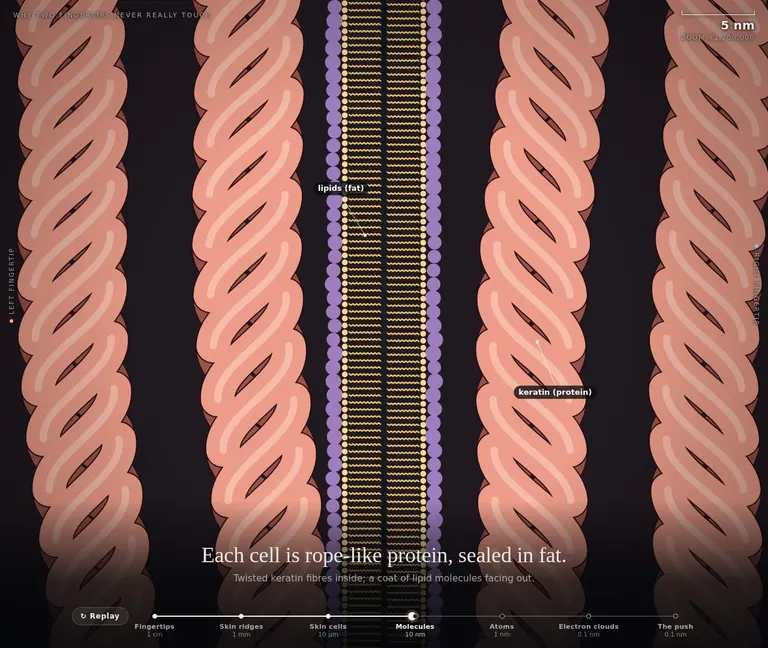
Output C, 1 turnTtamburinsNov 11Explain why two fingertips never really touch, as an interactive visualization in one HTML file. Start on two fingertips about to meet, then zoom in step by step: skin, cells, molecules, atoms, until the viewer sees the electron clouds pushing back before anything actually touches. Show the scale at each step and keep the explanation short and clear, like a great science video. It should play by itself in about 20 seconds when the page opens, then let me drag, scroll or replay to explore. Make it one HTML file that opens offline: no CDN links and no network requests. If you use a library like Three.js, put it inside the file. No image files, no image or video models. · 4LLMgoogle/gemini-4-carbonGen AI—Skill—SoftwareChromium+1$1.18·18m 30s·1.2M tokens00
Output D, 1 turnTtamburinsNov 11Explain why two fingertips never really touch, as an interactive visualization in one HTML file. Start on two fingertips about to meet, then zoom in step by step: skin, cells, molecules, atoms, until the viewer sees the electron clouds pushing back before anything actually touches. Show the scale at each step and keep the explanation short and clear, like a great science video. It should play by itself in about 20 seconds when the page opens, then let me drag, scroll or replay to explore. Make it one HTML file that opens offline: no CDN links and no network requests. If you use a library like Three.js, put it inside the file. No image files, no image or video models.LLMGPT-6.1 SolGen AI—Skill—SoftwareChromium+1$—·6m 15s·176.2K tokens00
Output B, 1 turnTtamburinsNov 11Explain why two fingertips never really touch, as an interactive visualization in one HTML file. Start on two fingertips about to meet, then zoom in step by step: skin, cells, molecules, atoms, until the viewer sees the electron clouds pushing back before anything actually touches. Show the scale at each step and keep the explanation short and clear, like a great science video. It should play by itself in about 20 seconds when the page opens, then let me drag, scroll or replay to explore. Make it one HTML file that opens offline: no CDN links and no network requests. If you use a library like Three.js, put it inside the file. No image files, no image or video models.LLMClaude Opus 5.5Gen AI—Skill—Software—$—·15m 36s·2.4M tokens00
Output A, 1 turnTtamburinsNov 11Explain why two fingertips never really touch, as an interactive visualization in one HTML file. Start on two fingertips about to meet, then zoom in step by step: skin, cells, molecules, atoms, until the viewer sees the electron clouds pushing back before anything actually touches. Show the scale at each step and keep the explanation short and clear, like a great science video. It should play by itself in about 20 seconds when the page opens, then let me drag, scroll or replay to explore. Make it one HTML file that opens offline: no CDN links and no network requests. If you use a library like Three.js, put it inside the file. No image files, no image or video models.LLMclaude-fable-5-2Gen AI—Skill—SoftwarePlaywright$—·15m 15s·789.1K tokens00
Output D, 1 turnTtamburinsNov 11Make one web page: a board of about 30 small UI components for a mobile app that helps a group of friends plan a weekend trip together, laid out as a bento grid on a light background. Every component is alive. Each one plays its own short interaction on a loop, as if an invisible person were using it: dates get picked on a calendar, a counter goes up and down, toggles flip, a dropdown opens and picks an option, text gets typed into a search field, a progress ring fills, a voice note plays with a moving waveform, a pay button shows a spinner and then a check. The loops are offset so the board never moves all at once, and it keeps going forever. It should look like a real product made by a senior product designer: one accent color, consistent corner radius, spacing and type, crisp at any size. No lorem ipsum: names, places, prices, dates and times should feel real and belong to the same trip. Make everything in code (HTML, CSS, JS, SVG or canvas; no image files, no image or video models). Put everything in one self-contained index.html with no network requests. It should fill a 16:10 browser window and still work on a phone. Test it in a headless browser and look at your own screenshots before you finish.LLMgoogle/gemini-4-carbonGen AI—Skill—SoftwareChromium+1$0.90·16m 58s·1.2M tokens00
Output C, 1 turnTtamburinsNov 11Make one web page: a board of about 30 small UI components for a mobile app that helps a group of friends plan a weekend trip together, laid out as a bento grid on a light background. Every component is alive. Each one plays its own short interaction on a loop, as if an invisible person were using it: dates get picked on a calendar, a counter goes up and down, toggles flip, a dropdown opens and picks an option, text gets typed into a search field, a progress ring fills, a voice note plays with a moving waveform, a pay button shows a spinner and then a check. The loops are offset so the board never moves all at once, and it keeps going forever. It should look like a real product made by a senior product designer: one accent color, consistent corner radius, spacing and type, crisp at any size. No lorem ipsum: names, places, prices, dates and times should feel real and belong to the same trip. Make everything in code (HTML, CSS, JS, SVG or canvas; no image files, no image or video models). Put everything in one self-contained index.html with no network requests. It should fill a 16:10 browser window and still work on a phone. Test it in a headless browser and look at your own screenshots before you finish.LLMClaude Opus 5.5Gen AI—Skill—SoftwareChromium+1$2.47·15m 48s·956.4K tokens00
Output B, 1 turnTtamburinsNov 11Make one web page: a board of about 30 small UI components for a mobile app that helps a group of friends plan a weekend trip together, laid out as a bento grid on a light background. Every component is alive. Each one plays its own short interaction on a loop, as if an invisible person were using it: dates get picked on a calendar, a counter goes up and down, toggles flip, a dropdown opens and picks an option, text gets typed into a search field, a progress ring fills, a voice note plays with a moving waveform, a pay button shows a spinner and then a check. The loops are offset so the board never moves all at once, and it keeps going forever. It should look like a real product made by a senior product designer: one accent color, consistent corner radius, spacing and type, crisp at any size. No lorem ipsum: names, places, prices, dates and times should feel real and belong to the same trip. Make everything in code (HTML, CSS, JS, SVG or canvas; no image files, no image or video models). Put everything in one self-contained index.html with no network requests. It should fill a 16:10 browser window and still work on a phone. Test it in a headless browser and look at your own screenshots before you finish.LLMGPT-6.1 SolGen AI—Skill—SoftwareChromium+1$—·7m 35s·200.6K tokens00
Output A, 1 turnTtamburinsNov 11Make one web page: a board of about 30 small UI components for a mobile app that helps a group of friends plan a weekend trip together, laid out as a bento grid on a light background. Every component is alive. Each one plays its own short interaction on a loop, as if an invisible person were using it: dates get picked on a calendar, a counter goes up and down, toggles flip, a dropdown opens and picks an option, text gets typed into a search field, a progress ring fills, a voice note plays with a moving waveform, a pay button shows a spinner and then a check. The loops are offset so the board never moves all at once, and it keeps going forever. It should look like a real product made by a senior product designer: one accent color, consistent corner radius, spacing and type, crisp at any size. No lorem ipsum: names, places, prices, dates and times should feel real and belong to the same trip. Make everything in code (HTML, CSS, JS, SVG or canvas; no image files, no image or video models). Put everything in one self-contained index.html with no network requests. It should fill a 16:10 browser window and still work on a phone. Test it in a headless browser and look at your own screenshots before you finish.LLMclaude-fable-5-2Gen AI—Skill—SoftwareGoogle Chrome+1$—·23m 3s·1.3M tokens00
1 turnTtamburinsNov 10Make one UI component in a single web page: a toggle switch that people want to keep clicking forever. The switch is a wide pill. Its track is a window into a tiny living pixel-art world: a lighthouse on a cliff above the sea, a small keeper who walks around, waves rolling in, gulls, drifting clouds. The knob is a glass marble that slides along the track and refracts the scene behind it like a real lens. Off is day, on is night. When it switches, the world changes over about a second with a dithered sunset or sunrise: the sky shifts, the lighthouse lamp turns on and sweeps the sea, the moon and stars come out. The page background changes with it. The click should feel physical: the knob squashes, overshoots and settles, with a soft click made in code. Make all the art in code (canvas or WebGL, no image files, no image or video models). Put everything in one self-contained index.html with no network requests. It has to work with mouse, touch and keyboard (space or enter), and it should look and feel like a finished product, not a demo. Test it in a headless browser, including toggling it several times, before you finish.LLMclaude-fable-5-2Gen AI—Skill—SoftwareChromium+1$—·19m 32s·672.5K tokens00
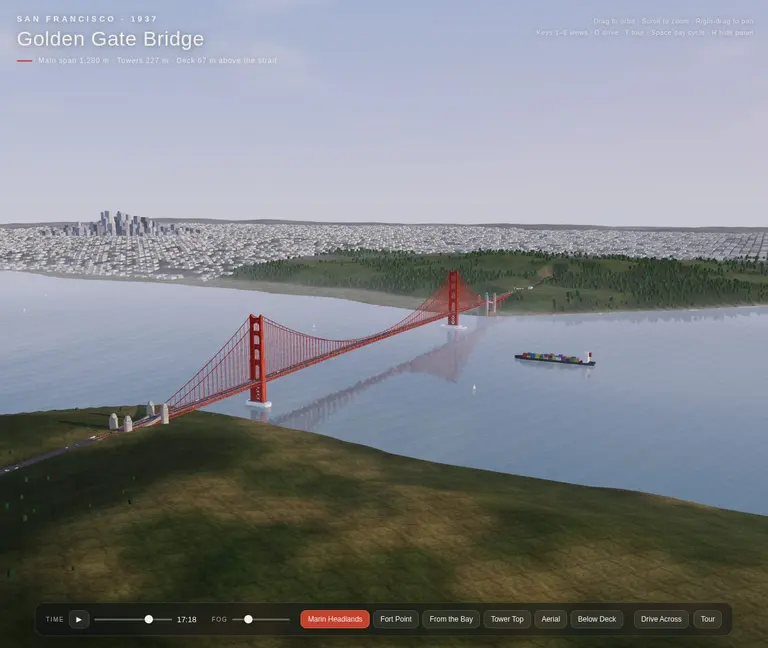
Output B, 1 turnTtamburinsNov 10Build the Golden Gate Bridge in 3D. Make it one HTML file that opens offline in a browser: no CDN links and no network requests. If you use a library like Three.js, put it inside the file. No image files.LLMClaude Opus 5.5Gen AI—Skill—SoftwareChromium+1$—·21m 12s·1.8M tokens00
Output A, 1 turnTtamburinsNov 10Build the Golden Gate Bridge in 3D. Make it one HTML file that opens offline in a browser: no CDN links and no network requests. If you use a library like Three.js, put it inside the file. No image files.LLMclaude-fable-5-2Gen AI—Skill—SoftwareGoogle Chrome$—·24m 25s·1.4M tokens00
Output D, 1 turnTtamburinsNov 10Make a browser game in one HTML file: a paper airplane gliding through a city at dusk. The player steers the plane between rooftops, through open windows and under bridges, catching warm lights while the wind pushes back. A run lasts about two minutes and ends on a hill above the city where kites are flying, with a short ending scene and a score. Include a title screen, keyboard and touch controls, and sound made in code. It should feel like a small indie game someone would share, not a tech demo. 3D is welcome. You may use Three.js, but put it inside the file (no CDN links), so it opens offline with no network requests. No images, no other libraries. Write it in one go: don't open it in a browser or test it. Just deliver the file.LLMGemini 4 ArgonGen AI—Skill—Software—$0.85·13m 3s·257.1K tokens00
Output C, 1 turnTtamburinsNov 10Make a browser game in one HTML file: a paper airplane gliding through a city at dusk. The player steers the plane between rooftops, through open windows and under bridges, catching warm lights while the wind pushes back. A run lasts about two minutes and ends on a hill above the city where kites are flying, with a short ending scene and a score. Include a title screen, keyboard and touch controls, and sound made in code. It should feel like a small indie game someone would share, not a tech demo. 3D is welcome. You may use Three.js, but put it inside the file (no CDN links), so it opens offline with no network requests. No images, no other libraries. Write it in one go: don't open it in a browser or test it. Just deliver the file.LLMGPT-6.1 SolGen AI—Skill—Software—$—·4m 19s·25.8K tokens00
Output B, 1 turnTtamburinsNov 10Make a browser game in one HTML file: a paper airplane gliding through a city at dusk. The player steers the plane between rooftops, through open windows and under bridges, catching warm lights while the wind pushes back. A run lasts about two minutes and ends on a hill above the city where kites are flying, with a short ending scene and a score. Include a title screen, keyboard and touch controls, and sound made in code. It should feel like a small indie game someone would share, not a tech demo. 3D is welcome. You may use Three.js, but put it inside the file (no CDN links), so it opens offline with no network requests. No images, no other libraries. Write it in one go: don't open it in a browser or test it. Just deliver the file.LLMClaude Opus 5.5Gen AI—Skill—Software—$3.40·21m 20s·826.3K tokens00
Output A, 1 turnTtamburinsNov 10Make a browser game in one HTML file: a paper airplane gliding through a city at dusk. The player steers the plane between rooftops, through open windows and under bridges, catching warm lights while the wind pushes back. A run lasts about two minutes and ends on a hill above the city where kites are flying, with a short ending scene and a score. Include a title screen, keyboard and touch controls, and sound made in code. It should feel like a small indie game someone would share, not a tech demo. 3D is welcome. You may use Three.js, but put it inside the file (no CDN links), so it opens offline with no network requests. No images, no other libraries. Write it in one go: don't open it in a browser or test it. Just deliver the file.LLMclaude-fable-5-2Gen AI—Skill—Software—$—·21m 43s·391.6K tokens00
Output B, 1 turnTtamburinsNov 10Build a snow globe that you can shake. Make it one HTML file that opens offline in a browser: no CDN links and no network requests. If you use a library like Three.js, put it inside the file. No image files.LLMClaude Opus 5.5Gen AI—Skill—SoftwareChromium+1$0.75·7m 52s·481.5K tokens00
Output A, 1 turnTtamburinsNov 10Build a snow globe that you can shake. Make it one HTML file that opens offline in a browser: no CDN links and no network requests. If you use a library like Three.js, put it inside the file. No image files.LLMclaude-fable-5-2Gen AI—Skill—SoftwareGoogle Chrome+1$—·19m 1s·836.6K tokens00
Output D, 1 turnTtamburinsNov 9Some design stores sell a three-seat sofa for $30,000. Design one I can build myself for a fraction of that, part by part, and give me the shopping list. Model it in Blender with Python (bpy, Cycles and EEVEE are installed). Every part is its own object with real dimensions in millimetres: frame rails, slats, legs, plywood panels, foam, fabric covers, screws and brackets. The parts must actually fit: no floating pieces, no parts passing through each other, and every board must be cut from standard sheet or lumber sizes. Use materials anyone can buy from a lumber yard, a foam shop and a fabric store. It should look like it came from a good design store, not like a box with cushions. Deliver: - render.png: the finished sofa in a simple, well-lit living room, 1920x1080 - exploded.png: an exploded view with every part numbered - bom.csv: part number, name, material, dimensions (mm), quantity, unit price (USD), where to buy it, line total - build.md: the cut list, assembly steps, total cost, how long a beginner would need to build it, and the hardest design decision you made - assembly.mp4: 1080x1080, 24 fps, 10 to 15 seconds, the sofa assembling itself part by part in build order, then one slow turn around it - the Python script Use typical US retail prices and say they are estimates. The machine has 4 CPU cores and FFmpeg, so keep the whole job under 60 minutes. Don't keep rendered frames in the workspace: encode them into the MP4 and delete them (the saved workspace is limited to 500 files and 100 MB). Don't end your turn while a render is still running.LLMGemini 4 ArgonGen AI—Skill—SoftwareBlender+1$6.25·1h 21m 35s·10M tokens00
Output C, 1 turnTtamburinsNov 9Some design stores sell a three-seat sofa for $30,000. Design one I can build myself for a fraction of that, part by part, and give me the shopping list. Model it in Blender with Python (bpy, Cycles and EEVEE are installed). Every part is its own object with real dimensions in millimetres: frame rails, slats, legs, plywood panels, foam, fabric covers, screws and brackets. The parts must actually fit: no floating pieces, no parts passing through each other, and every board must be cut from standard sheet or lumber sizes. Use materials anyone can buy from a lumber yard, a foam shop and a fabric store. It should look like it came from a good design store, not like a box with cushions. Deliver: - render.png: the finished sofa in a simple, well-lit living room, 1920x1080 - exploded.png: an exploded view with every part numbered - bom.csv: part number, name, material, dimensions (mm), quantity, unit price (USD), where to buy it, line total - build.md: the cut list, assembly steps, total cost, how long a beginner would need to build it, and the hardest design decision you made - assembly.mp4: 1080x1080, 24 fps, 10 to 15 seconds, the sofa assembling itself part by part in build order, then one slow turn around it - the Python script Use typical US retail prices and say they are estimates. The machine has 4 CPU cores and FFmpeg, so keep the whole job under 60 minutes. Don't keep rendered frames in the workspace: encode them into the MP4 and delete them (the saved workspace is limited to 500 files and 100 MB). Don't end your turn while a render is still running.LLMClaude Fable 5.1Gen AI—Skill—SoftwareBlender+1$13.20·45m 24s·7M tokens00
Output B, 1 turnTtamburinsNov 9Some design stores sell a three-seat sofa for $30,000. Design one I can build myself for a fraction of that, part by part, and give me the shopping list. Model it in Blender with Python (bpy, Cycles and EEVEE are installed). Every part is its own object with real dimensions in millimetres: frame rails, slats, legs, plywood panels, foam, fabric covers, screws and brackets. The parts must actually fit: no floating pieces, no parts passing through each other, and every board must be cut from standard sheet or lumber sizes. Use materials anyone can buy from a lumber yard, a foam shop and a fabric store. It should look like it came from a good design store, not like a box with cushions. Deliver: - render.png: the finished sofa in a simple, well-lit living room, 1920x1080 - exploded.png: an exploded view with every part numbered - bom.csv: part number, name, material, dimensions (mm), quantity, unit price (USD), where to buy it, line total - build.md: the cut list, assembly steps, total cost, how long a beginner would need to build it, and the hardest design decision you made - assembly.mp4: 1080x1080, 24 fps, 10 to 15 seconds, the sofa assembling itself part by part in build order, then one slow turn around it - the Python script Use typical US retail prices and say they are estimates. The machine has 4 CPU cores and FFmpeg, so keep the whole job under 60 minutes. Don't keep rendered frames in the workspace: encode them into the MP4 and delete them (the saved workspace is limited to 500 files and 100 MB). Don't end your turn while a render is still running.LLMGPT-6.1 SolGen AI—Skill—SoftwareBlender+1$—·45m 22s·3.7M tokens00
Output A, 1 turnTtamburinsNov 9Some design stores sell a three-seat sofa for $30,000. Design one I can build myself for a fraction of that, part by part, and give me the shopping list. Model it in Blender with Python (bpy, Cycles and EEVEE are installed). Every part is its own object with real dimensions in millimetres: frame rails, slats, legs, plywood panels, foam, fabric covers, screws and brackets. The parts must actually fit: no floating pieces, no parts passing through each other, and every board must be cut from standard sheet or lumber sizes. Use materials anyone can buy from a lumber yard, a foam shop and a fabric store. It should look like it came from a good design store, not like a box with cushions. Deliver: - render.png: the finished sofa in a simple, well-lit living room, 1920x1080 - exploded.png: an exploded view with every part numbered - bom.csv: part number, name, material, dimensions (mm), quantity, unit price (USD), where to buy it, line total - build.md: the cut list, assembly steps, total cost, how long a beginner would need to build it, and the hardest design decision you made - assembly.mp4: 1080x1080, 24 fps, 10 to 15 seconds, the sofa assembling itself part by part in build order, then one slow turn around it - the Python script Use typical US retail prices and say they are estimates. The machine has 4 CPU cores and FFmpeg, so keep the whole job under 60 minutes. Don't keep rendered frames in the workspace: encode them into the MP4 and delete them (the saved workspace is limited to 500 files and 100 MB). Don't end your turn while a render is still running.LLMClaude Opus 5.5Gen AI—Skill—SoftwareFFmpeg+1$3.90·50m 16s·5.1M tokens00
Output D, 1 turnTtamburinsNov 9Make one HTML file: a black hole you can look at in 3D, built with Three.js. Show the event horizon, a glowing accretion disk that swirls around it, and the light bending around the hole so the disk wraps over the top and under the bottom. Stars behind it should warp near the edge. Let me drag to orbit the camera and scroll to zoom. It should look like a still from a space film, not a screensaver. Put Three.js inside the file (no CDN links), so it opens offline with no network requests. No images, no other libraries. Before you finish, open it in a headless browser, take screenshots, look at them, and fix anything that doesn't look like a film still.LLMGemini 4 ArgonGen AI—Skill—SoftwareChromium+1$1.51·35m 0s·2M tokens00
Output C, 1 turnTtamburinsNov 9Make one HTML file: a black hole you can look at in 3D, built with Three.js. Show the event horizon, a glowing accretion disk that swirls around it, and the light bending around the hole so the disk wraps over the top and under the bottom. Stars behind it should warp near the edge. Let me drag to orbit the camera and scroll to zoom. It should look like a still from a space film, not a screensaver. Put Three.js inside the file (no CDN links), so it opens offline with no network requests. No images, no other libraries. Before you finish, open it in a headless browser, take screenshots, look at them, and fix anything that doesn't look like a film still.LLMClaude Fable 5.1Gen AI—Skill—SoftwareChromium+1$6.40·24m 49s·1.8M tokens00
Output B, 1 turnTtamburinsNov 9Make one HTML file: a black hole you can look at in 3D, built with Three.js. Show the event horizon, a glowing accretion disk that swirls around it, and the light bending around the hole so the disk wraps over the top and under the bottom. Stars behind it should warp near the edge. Let me drag to orbit the camera and scroll to zoom. It should look like a still from a space film, not a screensaver. Put Three.js inside the file (no CDN links), so it opens offline with no network requests. No images, no other libraries. Before you finish, open it in a headless browser, take screenshots, look at them, and fix anything that doesn't look like a film still.LLMGPT-6.1 SolGen AI—Skill—SoftwareChromium+1$—·14m 54s·244.5K tokens00
Output A, 1 turnTtamburinsNov 9Make one HTML file: a black hole you can look at in 3D, built with Three.js. Show the event horizon, a glowing accretion disk that swirls around it, and the light bending around the hole so the disk wraps over the top and under the bottom. Stars behind it should warp near the edge. Let me drag to orbit the camera and scroll to zoom. It should look like a still from a space film, not a screensaver. Put Three.js inside the file (no CDN links), so it opens offline with no network requests. No images, no other libraries. Before you finish, open it in a headless browser, take screenshots, look at them, and fix anything that doesn't look like a film still.LLMClaude Opus 5.5Gen AI—Skill—SoftwarePlaywright$0.91·11m 25s·554.6K tokens00
Output D, 1 turnTtamburinsNov 9Make one UI component in a single web page: a toggle switch that people want to keep clicking forever. The switch is a wide pill. Its track is a window into a tiny living pixel-art world: a lighthouse on a cliff above the sea, a small keeper who walks around, waves rolling in, gulls, drifting clouds. The knob is a glass marble that slides along the track and refracts the scene behind it like a real lens. Off is day, on is night. When it switches, the world changes over about a second with a dithered sunset or sunrise: the sky shifts, the lighthouse lamp turns on and sweeps the sea, the moon and stars come out. The page background changes with it. The click should feel physical: the knob squashes, overshoots and settles, with a soft click made in code. Make all the art in code (canvas or WebGL, no image files, no image or video models). Put everything in one self-contained index.html with no network requests. It has to work with mouse, touch and keyboard (space or enter), and it should look and feel like a finished product, not a demo. Test it in a headless browser, including toggling it several times, before you finish.LLMGemini 4 ArgonGen AI—Skill—SoftwareChromium+1$0.82·15m 19s·459.1K tokens00